India Tightens Exam Fraud Laws After Student Protests Force Education Minister’s Exit
The new legislation, which doubles prison terms for exam leaks, comes after youth-led protests that called for sweeping reforms and forced a minister’s resignation.

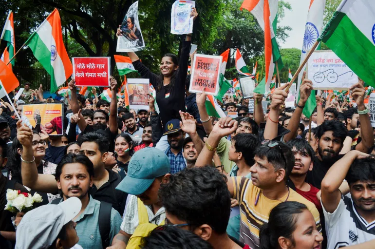
Cockroach Janta Party (CJP) supporters chant slogans, hold placards and wave national flag as they celebrate the resignation of Education Minister Dharmendra Pradhan over the National Eligibility Entrance Test (NEET) examination paper leaks, following a protest, in Mumbai, India.
Student-led demonstrations demanding accountability over widespread examination malpractice have prompted India’s Parliament to approve tougher penalties for exam paper leaks, marking one of the country’s most significant education reforms in recent years.
The legislation, passed by the upper house of Parliament on Thursday after clearing the lower chamber a day earlier, significantly increases the punishment for individuals involved in leaking examination papers. The bill now awaits the assent of President Droupadi Murmu before becoming law.
Stronger Penalties After Nationwide Outcry
Under the new legislation, the maximum prison sentence for those found guilty of leaking examination papers has been doubled from five years to 10 years. The law also raises the maximum financial penalty to more than $1 million, reflecting the government’s effort to deter organised examination fraud.
The measure was approved through a voice vote in the Rajya Sabha following several hours of debate among lawmakers.
Defending the bill before legislators, junior minister Jitendra Singh, who has been involved in discussions with student protesters, described examination integrity as a matter of national importance.
“This is an issue in which every parent, every family, and indeed every citizen of this country has a stake, because these young children are our greatest investment,” Singh told members of the upper chamber.
The stricter sanctions had earlier received approval from Prime Minister Narendra Modi’s cabinet before being forwarded to Parliament.
Protests Trigger Political Fallout
The legislative action follows weeks of widespread protests led largely by young people angered by repeated examination leaks and alleged irregularities in the country’s education system.
The demonstrations, organised by the online Cockroach Janta Party (CJP) movement, attracted thousands of students across India and evolved into one of the most significant public challenges faced by the Modi administration in recent months.
Public pressure intensified after allegations emerged over compromised examination processes, eventually leading to the resignation of Education Minister Dharmendra Pradhan on Saturday.
The protests called for sweeping reforms aimed at restoring confidence in India’s examination system and ensuring greater transparency in the conduct of national and state-level tests.
Longstanding Challenge for Authorities
Question paper leaks have remained a persistent concern across India despite repeated government efforts to curb examination malpractice. Both national and state examinations have experienced similar controversies over the years, affecting thousands of candidates and raising concerns about fairness in admissions and recruitment processes.
The issue gained renewed attention after investigators uncovered alleged irregularities surrounding a national medical college entrance examination conducted earlier this year.
Earlier this week, India’s federal investigative agency filed charges against 13 individuals accused of involvement in offences linked to the examination paper leak. The case became one of the major catalysts for the nationwide student demonstrations.
With Parliament now approving tougher punishments, authorities hope the new law will discourage organised examination fraud and strengthen public confidence in India’s education system.
The legislation represents a major policy response to growing public frustration, but attention will now shift to its implementation and whether stricter penalties will succeed in preventing future examination leaks.