AI Boom Sells Out Global Memory Chip Capacity Through 2027
Major chipmakers report that nearly all advanced memory production has already been reserved as AI companies race to secure long-term supply.

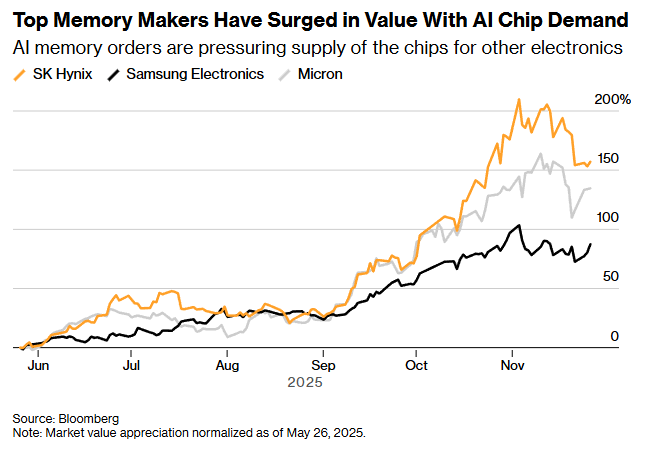
The global race to build artificial intelligence infrastructure has pushed the memory chip industry into an unprecedented supply crunch, with reports indicating that nearly all advanced memory chip production capacity for 2027 has already been committed. Leading manufacturers—including Samsung, SK hynix, and Micron—have signed long-term agreements with major AI customers, leaving little capacity available for new buyers. The shortage is being fueled by explosive demand for High Bandwidth Memory (HBM), a critical component used in AI accelerators powering large language models and cloud data centers.
Technology giants such as Nvidia, Microsoft, Amazon, Meta, Google, and OpenAI are investing hundreds of billions of dollars to expand AI infrastructure, prompting them to secure memory supplies years in advance. These companies require enormous quantities of HBM and advanced DRAM to support increasingly powerful AI systems. As a result, memory manufacturers are prioritizing long-term contracts with hyperscale customers, ensuring stable supply for strategic partners while limiting availability for smaller companies and traditional electronics manufacturers.
The shortage extends well beyond AI servers. Because manufacturers are dedicating more production lines to high-margin AI memory products, supplies of conventional DRAM and NAND flash used in PCs, smartphones, automotive electronics, and industrial equipment have also tightened. Industry analysts expect memory prices to remain elevated through 2027, with many hardware manufacturers already raising prices for graphics cards, laptops, and other consumer devices. Several semiconductor companies have also warned that demand continues to exceed production capacity despite aggressive investments in new fabrication plants and advanced packaging facilities.
To address the imbalance, memory manufacturers are investing billions of dollars in expanding fabrication plants and packaging capacity. Samsung is developing next-generation memory technologies, SK hynix continues to increase HBM output, while Micron is expanding production to meet future AI demand. However, building new semiconductor fabs takes several years, meaning additional capacity will not arrive quickly enough to ease the near-term shortage. Many analysts believe supply constraints could persist well beyond 2027 if AI infrastructure spending continues at its current pace.
The sellout of 2027 memory chip capacity underscores how artificial intelligence has transformed the semiconductor industry. Memory, once considered a cyclical market, has become one of the most strategically important technologies in the AI era. As cloud providers, governments, and enterprises continue deploying increasingly powerful AI systems, securing long-term memory supply is becoming just as important as acquiring advanced AI processors. The industry’s challenge over the next several years will be expanding production quickly enough to satisfy demand without disrupting supply for the broader global technology market.