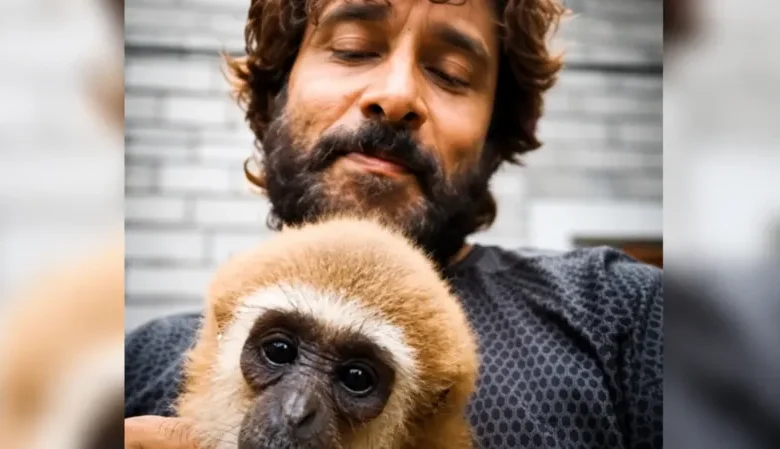
A video posted by a Tamil film star showing him cuddling an endangered gibbon has triggered an investigation by Indian wildlife officials over how he came into contact with the animal.
Vikram, an award-winning actor from the southern state of Tamil Nadu, was seen hugging and playing with a lar gibbon in a now-deleted video posted on Instagram on Monday.
The state’s forest department has since begun investigating how the gibbon came to be at a private home and whether rules governing its possession and transfer were followed.
They have not concluded that the animal was trafficked, or that Vikram owned it or was involved in bringing it into India.
Vikram has not commented on the controversy yet. His public relations officer, Yuvaraj, told BBC Tamil that the media would be informed if the actor issued a statement.
Lar gibbons are small apes native to south-east Asia whose international trade is tightly controlled.
Officials said the animal was being kept at the home of a relative of Vikram in Chennai, the capital of Tamil Nadu state.
The state’s Chief Wildlife Warden Rakesh Kumar Dogra told BBC Tamil that individuals could keep a lar gibbon if they had the permits and documentation required by law.
“An investigation is under way into where the lar gibbon came from. Only then can we say whether it was brought illegally,” he said.
The case has made national headlines. Vikram, whose real name is Kennedy John Victor, is one of the biggest names in Tamil cinema, India’s popular Tamil-language film industry. His career spans more than three decades and he is known for taking on unconventional and physically demanding roles.
They live in tropical forests in small family groups and are found across parts of south-east Asia, including Thailand, Myanmar and Malaysia.
The species is listed as endangered, with its numbers threatened by habitat loss, hunting and the illegal pet trade.
They are also protected under CITES, an international agreement that tightly restricts trade in endangered species.
India is among the countries that has incorporated protections for CITES-listed species into its wildlife laws. People who keep such animals must register them with wildlife authorities and follow rules governing their possession and transfer.
“To import exotic animals, it is necessary to submit a DGFT [Directorate General of Foreign Trade] permit and a no-objection certificate, and then a wildlife conservator’s certificate,” Dogra said.