Chinese Humanoid Robot Beats Usain Bolt’s 100m World Record in Test Run
Honor’s humanoid robot Lightning reportedly completed 100 metres in 9.32 seconds, faster than Usain Bolt’s 9.58-second human world record.

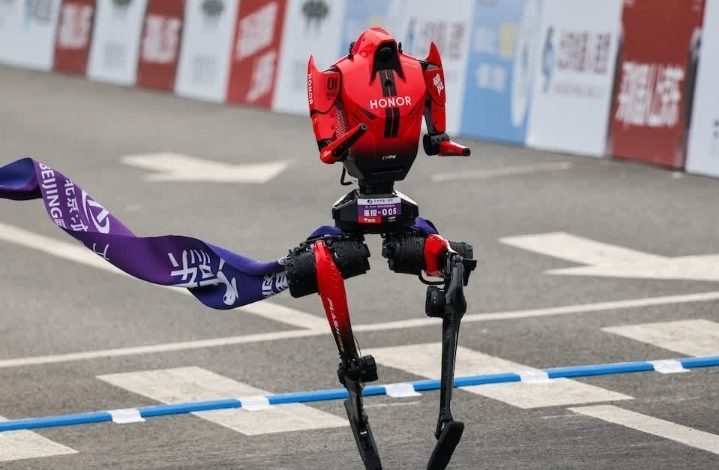
China has reported a remarkable new milestone in humanoid robotics. Lightning, a humanoid robot developed by Chinese smartphone company Honor, reportedly ran 100 metres in 9.32 seconds during a preparatory test in Beijing. That time is faster than Usain Bolt’s long-standing human world record of 9.58 seconds, set at the 2009 World Athletics Championships in Berlin.
Lightning reportedly reached a peak speed of 14.5 metres per second, demonstrating how quickly humanoid robots are advancing in mechanical movement and control. The run was conducted ahead of the second World Humanoid Robot Games, which opened in Beijing on August 22. Because this was a robot test rather than an official human athletics competition, the result does not replace Bolt’s official world record in track and field.
The robot has already demonstrated endurance as well as speed. In April, Lightning reportedly won a 21-kilometre Beijing humanoid-robot half marathon, completing the course in 50 minutes and 26 seconds. Researchers subsequently modified the robot ahead of the latest competition, including lengthening its legs from 95 centimetres to about 1.05 metres.
The achievement highlights China’s growing focus on humanoid robotics as a strategic technology industry. Chinese policymakers and companies are investing heavily in robots that could eventually operate in factories, warehouses, logistics environments and consumer applications. Improvements in artificial intelligence, actuators, batteries and robotic control systems are helping machines perform increasingly complex physical movements.
Lightning’s performance is therefore less about competing with human athletes and more about demonstrating what modern machines can physically achieve. A robot running faster than the fastest human over 100 metres shows how quickly robotics technology is progressing. As engineers continue improving balance, energy efficiency, artificial intelligence and mechanical design, humanoid robots could become increasingly capable of performing demanding real-world tasks.