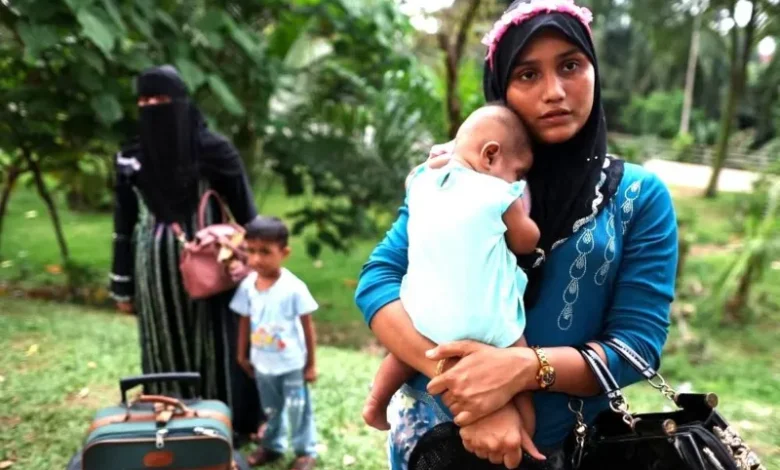
Not long ago, Malaysia’s then-prime minister appealed to his country to protect Rohingya Muslims – a stateless minority that has fled violence and discrimination in Myanmar for decades.
“We must defend them, not just because they are of the same faith, but [because] they are humans, their lives have value,” Najib Razak said in 2017.
Nine years on, a fierce new wave of hostility against the Rohingya is sweeping the nation.
So much so that “going to school has become a dangerous thing,” says Irhan, a Rohingya refugee, who founded a school in northern Malaysia for children from his community aged six to 15. We have changed his name to protect his identity.
Because Rohingya children are barred from Malaysian public schools, they often attend unlicensed, community-run “learning centres”, which are now especially vulnerable.
Irhan’s school was raided last month, when eight uniformed police officers stormed inside, took photographs of the students and ordered some of them to go home.
“The students are just here to learn. Now their families are afraid,” he says.
A school in Selangor in the west suspended classes for a month and reopened at the end of July with new instructions: students must not wear their uniforms to school and must go straight home after class, without lingering or hanging out in groups.
“We’re keeping a low profile to protect our students from getting attacked,” says Farooq, a Rohingya teacher.
Crackdowns are haphazard and often spurred by public sentiment. The uncertainty and fear have forced some schools to close in recent months. In some parts of the country, Rohingya have also been evicted from villages they’d been living in for years. Some local residents told Malaysian media that allowing them to remain could lead to “social problems”.
After they were evicted from a fishing village near Penang, some120 refugees sought shelter outside the UN’s refugee agency in the capital Kuala Lumpur – and were temporarily detained. More than half of them were children.
All of this has left a community that has long felt beleagured looking over its shoulder again.
“In the early years, the Malaysians were our friends. They cared for our children. But it’s changed,” Irhan says.
“I would leave if I could, but where else can I go? We are not wanted anywhere.”
The UN refugee agency estimates that more than 126,000 Rohingya have resettled in Malaysia, making it the second-largest host country, after Bangladesh, for Rohingya refugees. But some rights groups believe the actual number is far higher.
Rohingya Muslims are denied citizenship in their home country of Myanmar, a predominantly Buddhist state. Although Rohingya trace their roots going back centuries in what is now Rakhine state, successive Myanmar governments have claimed that they are illegal migrants.
Ethnic tensions with the local Buddhist population have flared repeatedly, displacing tens of thousands of Rohingya. They ended up in camps within Myanmar, or fled across the border.
But the biggest exodus began in August 2017, after a brutal military crackdown. The Myanmar army massacred thousands of them, raped Rohingya women and burned their villages.
It was what the UN called “textbook ethnic cleansing” and former US president Joe Biden’s administration determined as a genocide. Myanmar is now facing a landmark genocide case at the International Court of Justice, which saw deposed leader and Nobel Peace Prize winner Aung San Suu Kyi testify.
As Myanmar’s leader at the time, she was sharply criticised for how her government responded to the killings, including by playing down what was happening or suggesting that the severity of the violence was exaggerated.