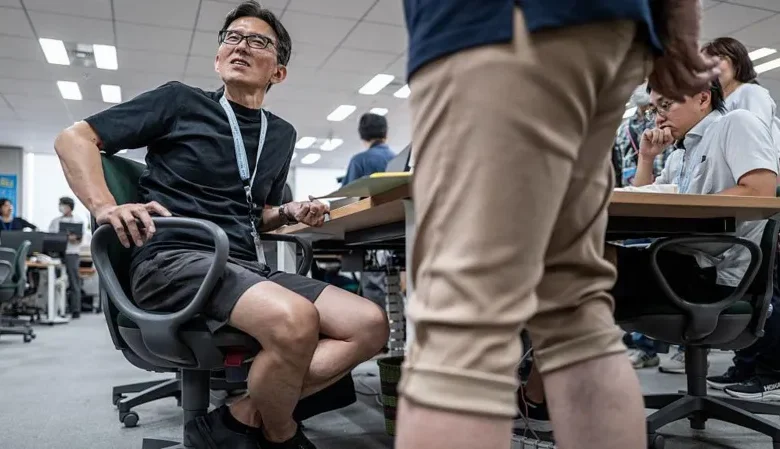
The Tokyo Metropolitan Government is pushing company employees to ditch their usual suit and tie for more casual attire, featuring t-shirts, trainers – and shorts.
Tokyo Governor Yuriko Koike introduced “Tokyo Cool Biz” in April, hoping to expand on her signature cool down initiative which has now become a widely recognised annual summer tradition.
Almost four months in, the newly allowed shorts in the office policy is getting mixed reviews.
Some commentators enjoy the relaxed rules, helping them work more comfortably. Others say the policy is unfair to women. Although not an official rule and more about etiquette, women are often still expected to wear tights when their work attire exposes their legs in a traditional Japanese office environment.
And a few women describe the experience of “leg hair harassment” or a term coined online as “sunehara”, referring to the discomfort of being forced to see their colleague’s leg hair.
“We want to give people more options in the severe heat, not tell them what to wear. There should be no issue as long as the work attire is not offensive to anyone,” Tokyo Metropolitan Government environmental official Noboru Watanabe told the BBC.
For those against shorts in the office the main reason, for both genders, was the concern over body shape and body hair. The clinic says women significantly outnumbered men in their response, indicating that women may be more resistant to seeing a male colleague’s bare legs.
In recent years more Japanese workers, notably those working at startups and tech companies, have started wearing casual clothes. But this year, the Tokyo government recommendation has made it more socially acceptable. Still, some men have been feeling self-conscious about their leg hair.
Akifumi Funatsu, the director of Gorilla Clinic, says he has noticed more clients coming to the clinic not just for cosmetic reasons, but as a matter of “social etiquette when wearing shorts”. He thinks women believe that “men should have less leg hair”, which has prompted them to seek laser hair removal so as not to offend those around them.
Japan temperatures soar over 40C, marking first ‘cruelly hot day’
Koike first introduced the summer wardrobe shift as Japan’s environment minister in 2005. She launched a national energy-saving campaign called “Cool Biz” to encourage company workers to opt for short-sleeve shirts.
Government leaders participated in the initiative, with then Prime Minister Junichiro Koizumi often seen in public without wearing a tie or jacket, helping get the word out.
A few years later following the Tohoku earthquake and tsunami in March 2011, the government launched “Super Cool Biz” which expanded the guidelines to help reduce energy use both at work and at home.
As with other parts of the world, Japan has been experiencing record heat in recent months while grappling with soaring energy prices driven by instability in the Middle East.