
Microduck Robot Preorders Surpass 20,000 After Viral Nvidia Demonstration
A flock of miniature walking robots developed by Pollen Robotics has attracted more than 20,000 preorders following an entertaining demonstration by Nvidia CEO Jensen Huang, highlighting growing public interest in affordable, programmable AI-powered machines.

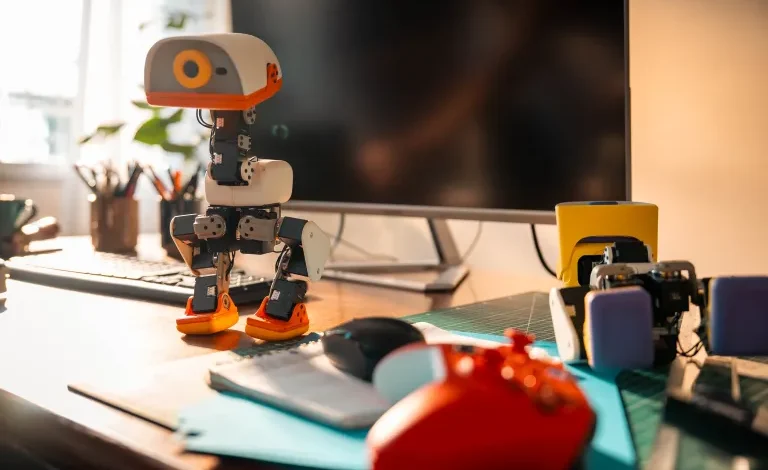
Microduck, a small bipedal robot developed by French robotics company Pollen Robotics, has surpassed 20,000 preorders following a demonstration at Nvidia’s GTC Berlin conference on October 21, 2026. The milestone was announced by Hugging Face CEO Clem Delangue after videos of Nvidia CEO Jensen Huang interacting with the miniature robots spread across social media. During the demonstration, Huang instructed the robots to sit down, pretend to fall asleep and perform somersaults. Most of the machines responded to the commands, while one required additional encouragement. The demonstration attracted widespread attention and helped turn the Microduck into one of the most talked-about consumer robotics products of the week. According to reporting by TechCrunch on October 23, the sudden surge in interest raised the possibility that the robot could become a popular technology gift during the 2026 Christmas season.
Microduck stands approximately 25 centimetres tall and weighs less than 800 grams, making it small enough to sit on a desk or move around a home. Despite its compact design, the robot contains 15 motors, a camera, a depth sensor and motion sensors that help it understand its surroundings and control its movements. Its articulated legs allow it to walk, sit, crouch and recover from many common falls, while its beak can pick up small objects. The robot can also perform additional movements, including roller-skating when fitted with suitable accessories. Pollen Robotics introduced Microduck in August 2026 with a starting price of $399 before taxes and shipping. It is available in four colours: cream, graphite, lavender and sky blue. The company designed the device to appeal to robotics enthusiasts, developers, educators and consumers interested in experimenting with interactive machines.
One of Microduck’s distinguishing features is its open-source approach. Rather than limiting owners to a fixed collection of movements, Pollen Robotics allows users to experiment with the robot’s software and train new behaviours. The machine comes with basic movements developed through simulation using artificial intelligence and robotics tools. Developers can modify these behaviours, experiment with reinforcement learning and share their results with other members of the community. This approach could make Microduck useful beyond entertainment, particularly for people learning about robotics, machine learning and physical AI. Researchers and students can use relatively affordable hardware to explore how software-controlled actions translate into movement in the real world. By making the robot’s software and training tools accessible, the company hopes to encourage a community that develops new movements and applications rather than relying exclusively on the manufacturer.
The surge in orders also reflects the growing interest in physical artificial intelligence, a field focused on enabling AI systems to perceive and interact with the physical world. Nvidia has been investing heavily in computing platforms that support robotics, simulation and machine learning, allowing developers to train virtual robots before transferring their learned behaviours to physical machines. Microduck uses this broader technology approach to develop movements that can be executed by its small mechanical body. During the Berlin demonstration, Huang used the robots to illustrate how simulated training and AI computing can help machines learn physical tasks. Hugging Face, the AI platform behind the project through its acquisition of Pollen Robotics in 2025, has also promoted open development as a way to encourage experimentation. The Microduck’s popularity suggests that robotics demonstrations can attract consumers when advanced technology is packaged in a compact, approachable and entertaining form.
Despite the excitement, passing 20,000 preorders does not necessarily mean that the company has already sold and delivered that number of robots. The figure was reported by Hugging Face’s leadership, and customers who place preorders may still have to wait for manufacturing and delivery. Pollen Robotics initially targeted deliveries before Christmas 2026 in North America, Europe and the United Kingdom, although meeting that schedule could become more challenging as orders increase. Producing thousands of small robots requires the company to coordinate motors, sensors, batteries, electronic components and quality-control processes while ensuring that each machine operates reliably. If Microduck can meet demand and maintain its promised functionality, it could become a notable example of how AI-powered robotics is moving towards the consumer market. Its long-term success, however, will depend on reliable delivery, software improvements and whether buyers continue using the robots after the initial excitement fades.




