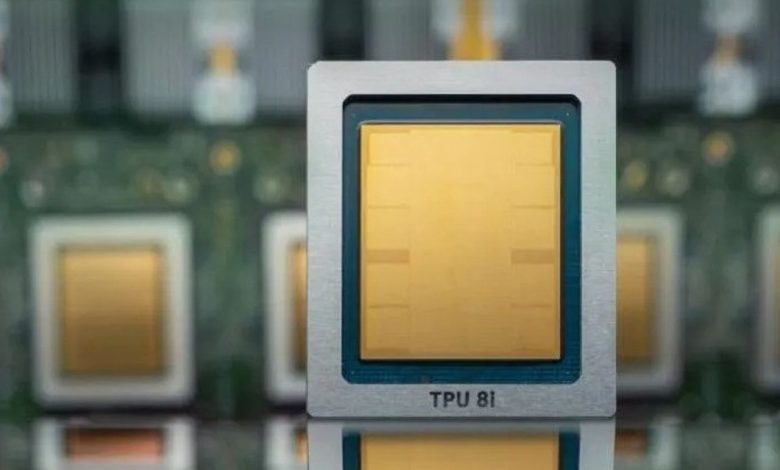
Google has expanded its artificial intelligence hardware portfolio with two specialised processors designed to improve data security and handle increasingly complex AI workloads. Announced on November 9, 2026, the new systems, TPU 8tx and TPU 8i Max, are aimed at businesses developing advanced AI agents and organisations that need stronger protection for sensitive information. The announcement strengthens Google’s effort to compete in the rapidly growing AI infrastructure market.
The TPU 8tx is designed for secure and confidential AI computing, particularly for governments and highly regulated industries. It combines Google’s TPU technology with fifth-generation AMD EPYC processor hosts to protect sensitive data and AI model weights even while they are being processed. Google says the system can deliver up to twice the performance speed of its TPU 8t predecessor in certain workloads, with almost no performance penalty, while supporting private model training and secure AI agent execution.
Meanwhile, the TPU 8i Max targets the growing demand for AI systems capable of processing extremely large amounts of information. Google has combined two TPU 8i chips into a single package, doubling computing power, SRAM capacity and high-bandwidth memory bandwidth. The design is intended to help multiple AI agents work across large software projects, lengthy videos and massive context windows without being slowed by memory limitations. It also fits within the existing rack footprint, allowing data centres to increase computing capacity without expanding the same amount of physical space.
The new processors complete Google’s eighth-generation TPU lineup, which now includes four systems designed for different AI tasks: TPU 8t for large-scale training, TPU 8i for real-time reasoning, TPU 8tx for confidential computing and TPU 8i Max for massive context workloads. Google says its TPU business now serves nearly 100 customers, including technology companies, trading firms, retailers and universities. Both newly announced systems are expected to become available in 2027, positioning Google to strengthen its presence in the AI chip market.