Nvidia Chip Demand Far Outpaces Supply as Global AI Race Accelerates
Explosive demand for Nvidia's AI processors continues to exceed manufacturing capacity, highlighting the unprecedented scale of global investment in artificial intelligence infrastructure and reinforcing Nvidia's dominant position at the center of the AI revolution.

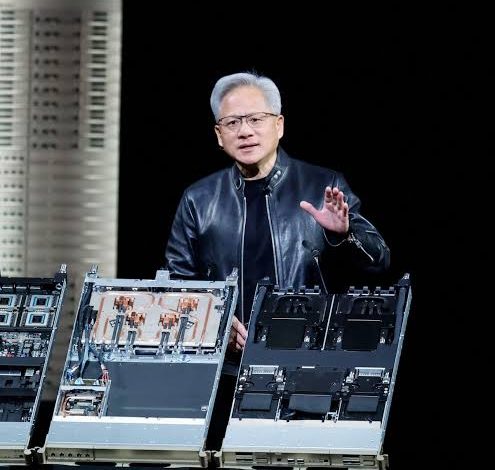
The artificial intelligence boom is showing no signs of slowing, and nowhere is that more evident than in the soaring demand for Nvidia’s AI chips. According to industry reports, demand for the company’s advanced processors continues to far exceed available supply, despite aggressive efforts to increase production. The imbalance underscores the extraordinary pace at which businesses, cloud providers, governments, and research institutions are investing in AI infrastructure, making Nvidia one of the most strategically important companies in the global technology industry.
Over the past several years, Nvidia has transformed from a company primarily known for gaming graphics cards into the undisputed leader of the AI hardware market. Its graphics processing units (GPUs), originally designed to render complex graphics, have become the preferred computing platform for training and deploying large language models, generative AI applications, scientific simulations, robotics, and autonomous systems. Today, nearly every major AI company depends on Nvidia hardware to power its most advanced workloads.
The surge in demand has been driven by an unprecedented wave of investment from the world’s largest technology companies. Microsoft, Amazon, Google, Meta, Oracle, OpenAI, xAI, Anthropic, and many others are collectively spending hundreds of billions of dollars building AI data centers capable of supporting increasingly sophisticated artificial intelligence models. Each new facility requires tens of thousands—and in some cases hundreds of thousands—of high-performance GPUs connected through ultra-fast networking systems.
Modern AI models are vastly more computationally intensive than earlier machine learning systems. Training frontier language models involves processing trillions of data points over weeks or even months using enormous clusters of specialized processors. Once training is complete, those same models require additional computing power for inference—the process of generating responses for millions of users every day. As AI adoption expands globally, demand for both training and inference hardware continues to grow at an extraordinary rate.
Nvidia’s latest processors have become particularly valuable because they combine exceptional computing performance with advanced memory systems, high-speed interconnects, and software optimized specifically for artificial intelligence. The company’s CUDA software ecosystem has become an industry standard, allowing developers to build AI applications that fully exploit Nvidia hardware. This combination of hardware and software has created a competitive advantage that many rivals have struggled to match.
Despite substantial investments in manufacturing capacity, supply has struggled to keep pace with demand. Producing advanced AI chips is one of the most complex manufacturing processes in the world. These processors contain tens of billions of transistors built using cutting-edge semiconductor fabrication technologies measured in just a few nanometers. Manufacturing requires highly specialized equipment, advanced packaging techniques, high-bandwidth memory, and extensive quality testing, all of which limit how quickly production can be expanded.
Nvidia also depends heavily on manufacturing partners, particularly Taiwan Semiconductor Manufacturing Company (TSMC), the world’s largest contract chipmaker. TSMC’s advanced fabrication facilities produce many of the most sophisticated chips used throughout the technology industry, serving customers including Nvidia, Apple, AMD, Qualcomm, and others. Although TSMC continues investing billions of dollars in new production capacity, expanding semiconductor manufacturing takes years rather than months due to the complexity and cost of constructing advanced fabrication plants.
The shortage extends beyond GPUs themselves. High-bandwidth memory (HBM), advanced chip packaging technologies, networking equipment, and power infrastructure have all become critical bottlenecks in AI deployment. Building an AI data center requires coordinating multiple components from different suppliers, meaning delays in any part of the supply chain can slow the deployment of entire AI clusters.
The impact of Nvidia’s supply constraints is being felt across the global technology sector. Cloud providers are competing aggressively to secure AI hardware for their customers, while startups often face long waiting periods before receiving the computing resources needed to develop and train new AI models. Some organizations have turned to renting GPU capacity through cloud platforms rather than purchasing hardware outright, creating a rapidly expanding market for AI infrastructure as a service.
Governments are also entering the competition. Recognizing artificial intelligence as a strategically important technology, countries across North America, Europe, Asia, and the Middle East are investing heavily in national AI infrastructure. Many governments are seeking access to advanced AI chips to support scientific research, healthcare innovation, defense applications, climate modeling, and economic development. This growing public-sector demand further intensifies competition for limited semiconductor supplies.
The ongoing shortage has strengthened Nvidia’s financial performance, with the company consistently reporting record revenue and profits as customers continue placing massive orders despite limited availability. Investors increasingly view Nvidia not simply as a semiconductor company but as the foundational infrastructure provider for the global AI economy. Its market valuation has risen dramatically, reflecting expectations that demand for AI computing will remain exceptionally strong for years to come.
At the same time, competitors are working aggressively to challenge Nvidia’s dominance. Companies including AMD, Intel, Google, Amazon, Microsoft, and numerous AI hardware startups are developing specialized processors designed to compete in different segments of the AI market. Several hyperscale cloud providers have introduced custom AI chips tailored for their own services, seeking to reduce dependence on third-party suppliers while improving efficiency for specific workloads.
Nevertheless, industry analysts believe Nvidia retains a significant lead thanks to its mature software ecosystem, extensive developer community, broad product portfolio, and years of experience optimizing hardware specifically for AI applications. Even as competition increases, demand for Nvidia’s products remains far greater than current production capacity.
Looking ahead, experts expect AI infrastructure investment to continue accelerating as enterprises integrate artificial intelligence into virtually every aspect of their operations. Applications ranging from autonomous vehicles and robotics to healthcare diagnostics, financial modeling, industrial automation, scientific research, education, and entertainment all require enormous computational resources. This expanding range of use cases suggests that demand for AI processors is likely to remain robust well into the next decade.
To address growing demand, Nvidia and its manufacturing partners continue investing heavily in expanding production capacity, developing more powerful chip architectures, improving energy efficiency, and advancing next-generation packaging technologies. These investments are expected to gradually ease supply constraints, although analysts caution that demand may continue growing faster than manufacturing capacity for the foreseeable future.
The current imbalance between supply and demand represents more than a temporary market shortage—it reflects a fundamental transformation taking place across the global economy. Artificial intelligence is becoming a foundational technology comparable to electricity, the internet, and cloud computing, and the specialized processors that power AI have become some of the world’s most valuable technological assets.
Nvidia’s continued supply challenges therefore highlight the extraordinary scale of the AI revolution. Every new language model, autonomous robot, scientific simulation, healthcare application, and intelligent software platform depends on powerful computing infrastructure, and Nvidia remains at the center of that transformation. As organizations worldwide race to harness artificial intelligence, securing access to advanced AI chips has become one of the defining technological priorities of the modern era.