Genome Study Reveals Surprising Ancestral Link Between Hawaii and Easter Island
A major genetic study of more than 1,000 Polynesians has uncovered new evidence about ancient Pacific migrations, revealing a close ancestral connection between Native Hawaiians and the people of Rapa Nui, also known as Easter Island.

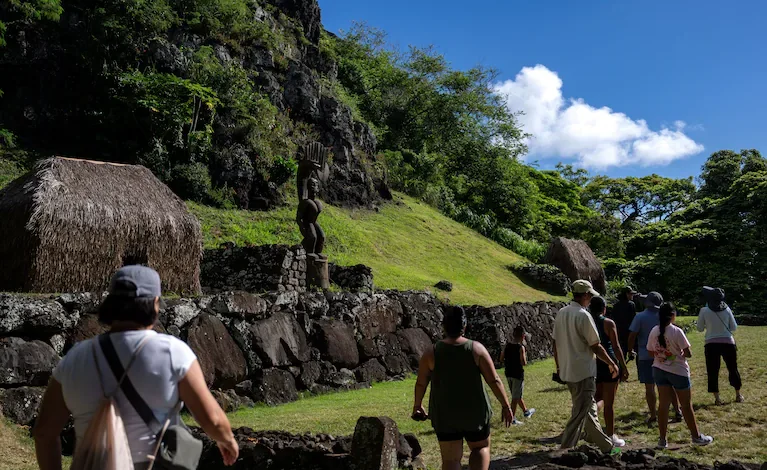
Scientists have uncovered new evidence about how Polynesian voyagers settled some of the most remote islands in the Pacific Ocean. A study published on October 8, 2026, in the scientific journal Science analysed whole-genome sequences from 1,050 individuals across Polynesia to reconstruct the population history of the region. The research found that Native Hawaiians and the people of Rapa Nui are more closely related genetically than either population is to other remote Polynesian groups included in the analysis. The discovery is particularly remarkable because Hawaii and Rapa Nui are separated by approximately 7,000 kilometres of ocean. The findings provide new genetic evidence of the extraordinary long-distance navigation skills that enabled Polynesian communities to establish settlements across the Pacific centuries before modern navigation technology existed.
The research suggests that the settlement of these islands followed a series of migrations involving relatively small groups of people moving from one island community to another. The researchers describe this process as a series of nested genetic bottlenecks. Each time a group left an established settlement to colonise another island, it carried only part of the genetic diversity of the population from which it originated. Over many generations, this repeated process changed the genetic composition of communities across the Pacific. The findings suggest that the ancestral journey connecting Hawaii and Rapa Nui passed through Mangareva, in French Polynesia, challenging the traditional account that places the Marquesas Islands at the centre of Hawaii’s founding migration. The results also support the idea that Polynesian voyaging involved repeated movements between islands rather than a single, straightforward migration in one direction.
Researchers reconstructed parts of this history by comparing genetic similarities, shared DNA segments and statistical models of ancestral relationships. They also used thousands of reconstructed population trees to test whether the genetic connection between Hawaii and Rapa Nui remained consistent across different analyses. The results repeatedly identified the two populations as close relatives among the remote island groups examined. The study also estimated that settlement in the Society Islands occurred around the late 11th century, with a genetic estimate of approximately 1069 matching archaeological evidence that places settlement between about 1025 and 1120. These findings demonstrate how modern genomic analysis can complement archaeology, linguistics and oral histories to develop a more detailed understanding of ancient migration. However, DNA alone cannot establish every voyage or prove the exact route taken by individual ancestral communities.
Beyond its historical significance, the study raises important questions about healthcare and inherited diseases among Polynesian populations. When small groups establish new communities, certain genetic variants carried by the original settlers can become more common in later generations. This is known as the founder effect. Researchers identified several disease-associated variants at elevated frequencies in French Polynesian populations, including variants associated with inherited eye conditions and a rare kidney disease. Some of these variants are poorly represented or absent in major international genomic databases, which have historically included limited information from Polynesian communities. This gap can make it harder for healthcare professionals to recognise certain inherited conditions or determine which genetic tests may be useful. The researchers emphasised that the results support further investigation and better representation of Polynesian populations in medical research; they do not, by themselves, establish new screening guidelines for every Pacific Island community.
The findings could influence future research into precision medicine, population genetics and the history of human migration. Scientists hope that more representative genomic datasets will help healthcare professionals identify inherited conditions more accurately while ensuring that Indigenous communities retain meaningful control over how their genetic information is collected, stored and used. The researchers have stressed the importance of involving local communities and ensuring that they benefit from research conducted with their participation. At the same time, the study highlights the achievements of Polynesian navigators, whose knowledge of stars, ocean currents, winds, birds and other natural signs enabled settlement across vast distances. By connecting genetic evidence with the history of Pacific exploration, the research demonstrates how ancient migration continues to shape both human ancestry and modern medical questions.