Google Launches Nano Banana 2.1 With Better AI Image Generation at Lower Cost
Google has introduced Nano Banana 2.1, an upgraded AI image-generation and editing model that promises improved visual quality, more accurate text rendering and stronger consistency while cutting standard image-generation prices by roughly half.

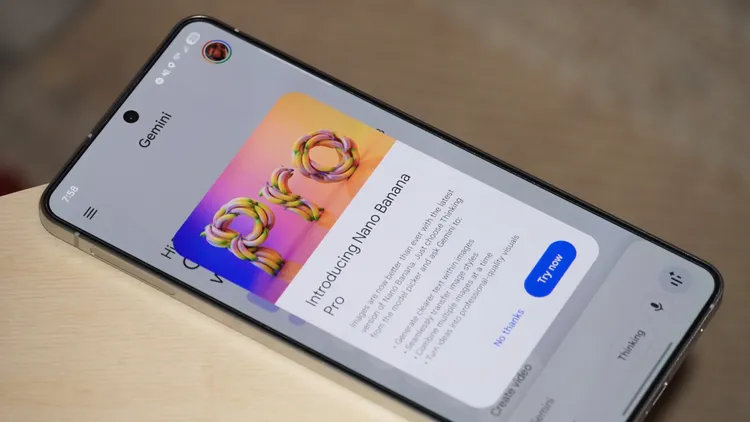
Google has launched Nano Banana 2.1, its latest artificial intelligence model for generating and editing images, as the company continues to expand its Gemini-powered creative tools. Announced on October 6, 2026, the model is designed to produce more realistic images, follow detailed instructions more accurately and support smoother editing across multiple stages of a project. Built on Google’s Gemini 3.6 Flash architecture, Nano Banana 2.1 aims to combine fast processing with capabilities previously associated with more expensive image-generation systems. Google is positioning the model as an efficient option for creators, businesses, developers and designers who need to generate high-quality visual content without paying premium prices for every image.
One of the most notable improvements is the model’s ability to maintain consistency when generating or editing images. Google says Nano Banana 2.1 can process up to 14 reference images in a single workflow, helping users preserve the appearance of as many as four characters and maintain the details of up to ten objects. This capability could be useful for advertising campaigns, product photography, digital storytelling, comic illustrations and brand design, where characters or products need to look similar across several images. The model also supports targeted, mask-based editing, allowing users to modify selected areas without unnecessarily changing the rest of an image. These improvements are intended to make AI-generated visuals more practical for professional creative work.
Another major improvement concerns text rendering and infographic production. AI image generators have historically struggled to reproduce small lettering, organise complex layouts and maintain accurate details in posters, diagrams and promotional materials. Google says Nano Banana 2.1 performs better in these areas and has reported improvements in its internal benchmark tests. Its published results show an infographic-factuality score of 0.521 with the model’s higher thinking setting, compared with 0.179 for the previous Nano Banana 2 model in the cited evaluation. These results suggest progress, although they come from Google’s own testing and do not guarantee that every generated infographic will be factually correct. Users should continue checking names, figures, labels and other important information before publishing AI-generated content.
Cost is another important part of the launch. Google’s published developer pricing lists Nano Banana 2.1 at approximately $0.0336 for a standard 1K image, compared with $0.067 for the previous Nano Banana 2 model at the same resolution. The company has also reduced the listed prices for 2K and 4K image outputs. Lower costs could make it easier for developers and businesses to generate large numbers of images for websites, online stores, marketing campaigns and mobile applications. However, total API expenses may also depend on input tokens, additional processing and other usage charges. The model is therefore particularly relevant to developers who want to balance visual quality, speed and operating costs when building AI-powered creative services.
Nano Banana 2.1 is being made available through several Google products and developer services, including the Gemini app, Google AI Studio, the Gemini API and AI Mode in Google Search, with additional integrations across Google’s creative and advertising tools. Developers can use the API to incorporate image generation and conversational editing into their own applications. Google also supports different thinking levels, allowing users to adjust how much processing the model applies to a task. Despite these capabilities, the company acknowledges limitations, including occasional problems with small text and imperfect image edits. Availability and usage limits may also differ across products and regions. These factors mean users should test the model with their specific requirements before relying on it for high-volume production work.
The launch places Google in continued competition with OpenAI and other companies developing advanced image-generation systems. Although Nano Banana 2.1 offers improved performance at a lower listed price than its predecessor, it does not automatically outperform every competing model in every task. Google’s own evaluations indicate progress in visual quality, consistency and editing, while independent comparisons provide a separate way to assess how models perform on real-world prompts. For creators and businesses, the most useful choice will depend on the type of images they produce, the accuracy they require and the amount they are prepared to spend. Nano Banana 2.1 nevertheless represents another step towards making sophisticated AI image generation more accessible to developers and everyday users.