With 70% of votes counted in Israel elections, neither of the two main blocs are on track for a majority
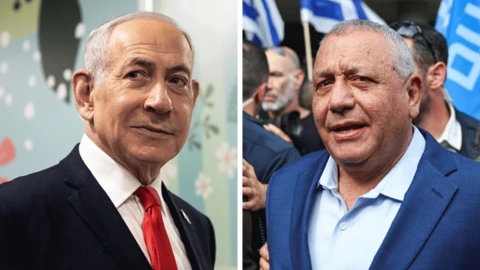
Gadi Eisenkot leads the newly formed Yashar party and is the main figure in the “change bloc”. Results suggest Benjamin Netanyahu’s Likud is set to be the biggest single party
Netanyahu calls for a “strong” right-wing government, Eisenkot insists Israel voted to end Netanyahu’s term
Parties led by Israel’s Arab minority could emerge as kingmakers, says BBC’s Yolande Knell
All 120 seats in the Knesset, Israel’s parliament, are up for grabs, but no party has ever won a majority and in the past governments have been made up of coalitions
More than 70% of the votes have now been counted, according to Israel’s central election committee, with no bloc currently looking like it will win a majority in Israel’s parliament.
Benjamin Netanyahu’s bloc still has the most votes but its seat count has lowered to 54.
Gadi Eisenkot’s opposition bloc has also lost two seats, taking its share to 47 seats, while Arab list parties have increased their number of seats to 19.
The winning bloc needs at least 61 seats in the Knesset to form a majority government.
The current results are not final and are subject to change.
Prof Eugene Rogan, director of the Middle East Centre at St Antony’s College, University of Oxford, says the election results are a “snapshot of just how polarised Israeli society is”.
Speaking to BBC Radio 4’s Today programme, Rogan says “the demand for change” among some voters, which was harnessed by Gadi Eisenkot’s opposition bloc, has been confronted by other voters who have “an absolute determination to preserve right-wing Netanyahu policies, which act as “a sort of security guarantee for the Israeli state”.
Asked about the impact of the Hamas-led attacks of 7 October, Rogan says this also split Israelis.
“For lots of Israelis they see the cost of never-ending wars, in terms of the hit Israel’s economy is taking, the exhaustion of hundreds of thousands of reservists who keep being called up for more tours of duty, the way in which Israel’s standing in the international community has been lowered, and they want change.
“But then for others they are absolutely convinced that you can never live with the Palestinians”, and think “they are an existential threat, and so is Iran – and the only person addressing those threats is Netanyahu”.
“Israelis are split”.