Hubble Captures Massive Superbubble in a Nearby Galaxy
Stunning New Image of N44 Reveals a Giant Cosmic Cavity, Glowing Gas and Thousands of Young Stars in the Large Magellanic Cloud

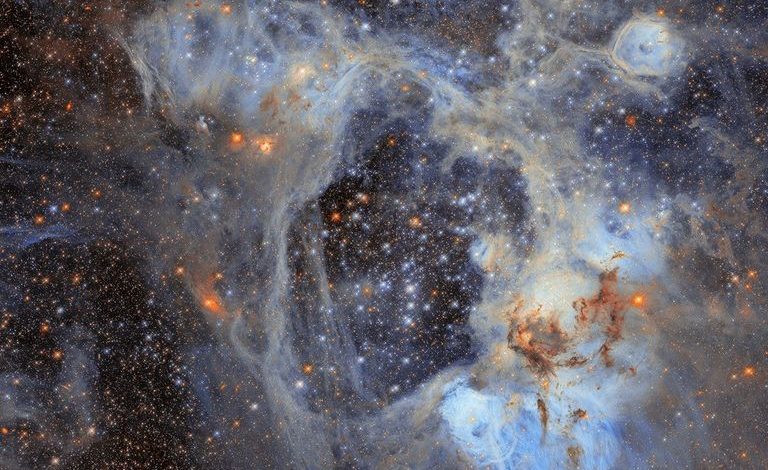
NASA’s Hubble Space Telescope has captured a detailed view of N44, a spectacular nebula located in the Large Magellanic Cloud, one of the small galaxies orbiting the Milky Way. Located approximately 160,000 light-years from Earth in the constellation Dorado, N44 is an active region of star formation. The newly highlighted Hubble image reveals an enormous central cavity surrounded by glowing gas, dust and countless stars.
At the heart of N44 is what astronomers call a superbubble—a vast region measuring roughly 210 by 140 light-years across. The enormous cavity was created as powerful stellar winds and explosions from massive stars pushed large amounts of gas away from the center of the nebula. The displaced material formed a dense shell surrounding the cavity, creating the striking structure visible in Hubble’s observations.
The region is more than just a spectacular cosmic structure. The shell surrounding the superbubble is being energized by ultraviolet radiation from massive stars, causing the gas to glow. Astronomers have also found evidence that new stars are forming within the compressed material around the bubble. This makes N44 an important natural laboratory for studying how clouds of gas collapse and eventually produce new stars.
Hubble’s observations have revealed an enormous population of stars in the region. Researchers catalogued nearly half a million stars in and around the N44 complex, including almost 30,000 pre-main-sequence stars—young stars that have not yet begun sustained hydrogen fusion in their cores. Studying these young objects could help scientists better understand how long the different stages of star formation take.
The image also contains smaller structures within the larger nebula, including N44F, an interstellar bubble shaped by the powerful winds and radiation of a single massive star. Together, these features show how young, massive stars can dramatically reshape their surroundings. Scientists say observations of N44 are particularly valuable because the Large Magellanic Cloud has fewer elements heavier than helium than environments such as the Milky Way, offering a useful comparison with star-forming regions in the early universe.