
Chinese AI Models Narrow the Gap With US Rivals as Competition Intensifies
New industry assessments show that Chinese AI developers are approaching American competitors in several performance benchmarks, while lower operating costs and open-weight models are strengthening China’s position in the global artificial intelligence race.

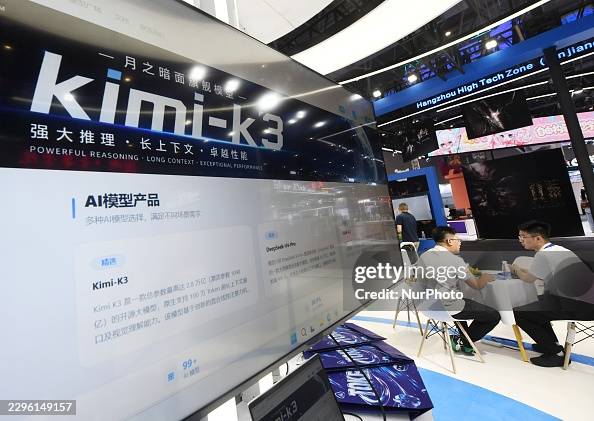
China is rapidly narrowing the performance gap between its leading artificial intelligence models and those developed by major American technology companies. Recent assessments highlighted by Bloomberg Intelligence indicate that the difference between leading Chinese and US models has decreased significantly as companies such as DeepSeek, Alibaba and Moonshot AI continue improving their systems. According to a report published by Bloomberg on October 4, Chinese models trailed their US counterparts by approximately 3% on the benchmarks examined, compared with around 9% in May and 15% earlier in 2026. The findings suggest that China’s AI industry is becoming increasingly competitive in areas such as reasoning, programming and automated task execution. However, benchmark results vary according to the models tested, the tasks evaluated and the methodology used, meaning that no single score establishes overall superiority.
One of the major contributors to China’s progress is the development of more computationally efficient AI systems. Chinese companies have increasingly focused on improving model architectures, optimising training methods and reducing the computing resources required to achieve competitive results. DeepSeek has attracted international attention for developing models that perform strongly on selected reasoning and programming benchmarks, while Alibaba’s Qwen family and Moonshot AI’s Kimi models have expanded the range of Chinese alternatives available to developers. These advances are particularly significant because Chinese AI developers have faced restrictions on access to some advanced American semiconductor technologies. By improving efficiency and developing alternative approaches, Chinese companies are attempting to reduce their dependence on the most powerful and expensive computing hardware.
Another important factor is China’s growing emphasis on open-weight AI models, which allow developers to download model parameters and adapt them for different applications, subject to their licences. This approach can make AI technology more accessible to businesses, researchers and independent developers who do not want to depend entirely on proprietary services. A Mozilla report published in September 2026 estimated that leading Chinese open-weight models were approximately four months behind the strongest closed models in certain capability comparisons. The report also highlighted substantial cost advantages for some open models. Nevertheless, open-weight does not necessarily mean fully open-source, and the most capable systems can still require expensive hardware and considerable technical expertise to operate. Even with these limitations, the approach is helping Chinese developers expand their international reach and compete on price as well as performance.
The growing competitiveness of Chinese AI companies is also influencing the global technology market. Businesses increasingly have access to multiple AI providers, allowing them to compare performance, operating expenses, privacy requirements and deployment options before choosing a model. Lower-cost Chinese alternatives could put pressure on American companies that rely on premium subscriptions and expensive API services to generate revenue from their AI investments. At the same time, the competition is extending beyond language models into AI agents, software development, scientific research and enterprise automation. Goldman Sachs has described the market as increasingly divided into US-centred and China-centred AI ecosystems, reflecting differences in investment, technology access, national security priorities and commercial strategies. This competition could influence how companies around the world build their AI infrastructure and select technology partners.
Despite China’s progress, important challenges remain. Access to advanced chips, the cost of large-scale computing infrastructure, model reliability and the availability of independent safety evaluations continue to influence the industry’s development. There are also concerns about transparency and the methods used to train some AI systems. In September, US cybersecurity agencies alleged that several Chinese AI developers had used large-scale distillation campaigns to extract capabilities from American models; the allegations have not been independently established in every individual case. Meanwhile, a recent report examining hundreds of Chinese model releases found that publicly disclosed, model-specific safety evaluations were uncommon, although the absence of published results does not prove that private testing was not conducted. Ultimately, China’s progress shows that the AI race is becoming more competitive, but sustained leadership will depend on more than benchmark scores alone.




