Rubin Observatory Discovers Potential New Dwarf Planet Beyond Pluto
Astronomers have identified a large icy object named 2026 ED138 beyond Neptune, with early estimates suggesting it could become the sixth officially recognised dwarf planet in our Solar System.

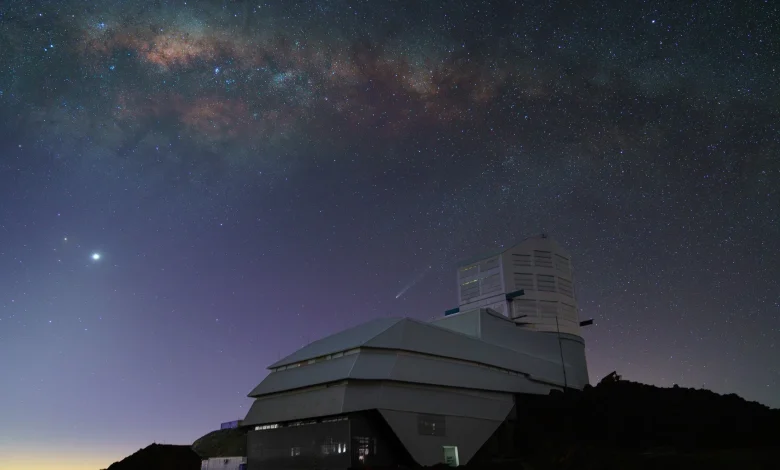
Astronomers using the NSF–DOE Vera C. Rubin Observatory in Chile have discovered a potential new dwarf planet in the distant regions of our Solar System. The object, provisionally designated 2026 ED138, was identified in observations collected during the observatory’s early operations in 2026. The discovery was announced on October 27, 2026, by the International Astronomical Union’s Minor Planet Center. Initial analysis suggests that ED138 could be one of the largest and brightest objects ever identified in the region beyond Neptune. If its size and physical characteristics are confirmed, it could become the sixth officially recognised dwarf planet, joining Pluto, Ceres, Eris, Haumea and Makemake.
The newly identified object is currently located approximately 46 astronomical units from the Sun, meaning it is about 46 times farther from the Sun than Earth. This places it beyond Pluto’s average orbital distance of approximately 40 astronomical units. Scientists estimate that ED138 could measure between 600 and 1,500 kilometres in diameter, although further observations are required to establish its actual size. At such distances, objects receive very little sunlight and are extremely difficult to observe. ED138 was particularly challenging to identify because it appears in a crowded region of the sky close to the plane of the Milky Way, where millions of background stars can make distant objects difficult to distinguish.
The discovery was made possible by Rubin Observatory’s powerful camera and advanced computer algorithms, which are designed to identify objects moving across repeated images of the sky. Researcher Matthew Holman of the Center for Astrophysics | Harvard & Smithsonian identified the object while analysing observations collected earlier in the year. Additional searches revealed 20 more observations in Rubin’s records, allowing scientists to trace its movement across multiple months. Researchers also located older images dating back to 2016 through archival observations from the Dark Energy Camera. By combining these records, the team was able to reconstruct more than a decade of the object’s orbital history and establish that it belongs to a group known as trans-Neptunian objects.
Scientists are particularly interested in ED138 because of what it could reveal about the formation and evolution of the Solar System. Its orbit is tilted by almost 25 degrees relative to the main plane of the planets, suggesting that gravitational interactions, particularly involving Neptune, may have influenced its present position. Trans-Neptunian objects are considered important remnants of the early Solar System because their composition and orbital movements preserve clues about how the giant planets migrated and how smaller icy bodies were distributed billions of years ago. Researchers believe ED138 could provide valuable information about these processes, especially if its physical size, surface properties and composition can be established through additional observations.
Despite the excitement surrounding the discovery, astronomers have not yet officially classified ED138 as a dwarf planet. To qualify, an object must orbit the Sun, possess enough mass for its own gravity to pull it into an approximately spherical shape, and not have cleared its orbital neighbourhood of other objects. Researchers currently believe ED138 may be large enough to meet the shape requirement, but infrared observations are needed to improve estimates of its size and confirm its physical characteristics. The discovery nevertheless demonstrates the growing capabilities of the Vera C. Rubin Observatory, which began its decade-long Legacy Survey of Space and Time in June 2026. As the telescope repeatedly scans the southern sky, scientists expect it to uncover thousands of additional asteroids and distant objects, potentially transforming humanity’s understanding of the outer Solar System.