Google Opens SynthID AI Detector to Everyone
Google has opened its SynthID Detector to the public worldwide, allowing users to check images, videos and audio for invisible watermarks linked to AI-generated or AI-edited content from Google and participating technology partners.

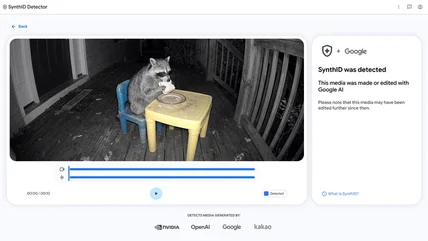
Google DeepMind has expanded access to its SynthID Detector, making the verification tool available globally in English after previously limiting access to journalists, media professionals and researchers. The standalone platform allows users to upload an image, video or audio file and check whether it contains a SynthID watermark. Google introduced SynthID in 2023 as a way of embedding invisible signals into AI-generated content without visibly changing its quality.
The technology works by embedding a hidden digital signal directly into generated media. For images and videos, the watermark is incorporated into the pixels, while audio receives a signal embedded in its waveform. Google says the watermark is designed to remain detectable after common modifications such as cropping, filtering, compression and changes to video frame rates. The company says more than 180 billion images and videos and the equivalent of 240,000 years of audio have already been watermarked through its AI systems.
A major development in the public release is that SynthID Detector is no longer limited to Google’s own AI systems. The tool can identify supported watermarks from Google and participating partners including OpenAI, NVIDIA and Kakao, while Apple is expected to join the system in the future. This creates a broader verification platform for AI-generated media rather than requiring users to rely on separate tools from individual AI companies.
However, Google emphasizes that SynthID Detector is not a universal AI detector. It can only identify media carrying a compatible SynthID watermark, meaning a negative result does not prove that a file was created by a human. Content generated by AI systems that do not use SynthID may not be detected, while changes to a file can sometimes weaken or remove provenance signals. The detector also does not necessarily distinguish between media created entirely by AI and media that was originally created by a person but later edited using AI.
The public release comes as the technology industry faces growing pressure to make AI-generated media easier to identify. Google says its verification features in Search, Gemini and Chrome now handle more than one million requests per day, while companies including OpenAI are also developing watermarking and provenance systems. The wider goal is to give people additional evidence about where digital content came from as AI-generated images, videos and audio become increasingly difficult to distinguish from authentic material.