
Meta and Apple Team Up to Run Powerful AI Models on Mac Computers
Meta and Apple have joined forces to bring Meta’s 816-billion-parameter Muse Spark Open AI model to high-end Mac computers, highlighting a growing industry shift towards running advanced artificial intelligence locally rather than relying entirely on cloud services.

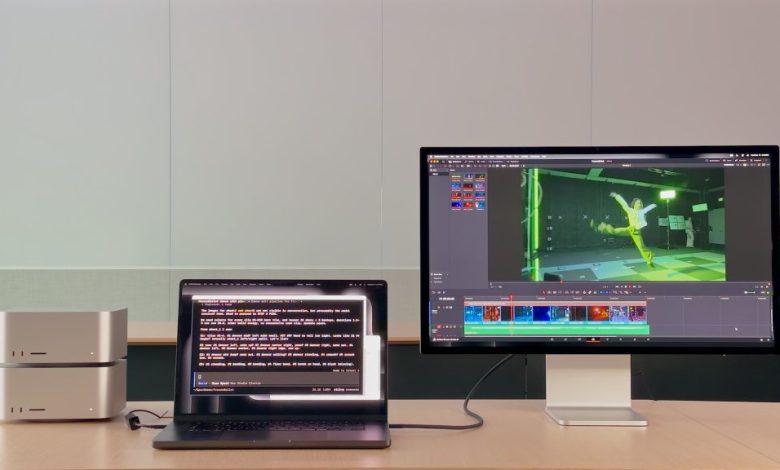
Meta has announced a collaboration with Apple to improve the performance of its latest open-weight artificial intelligence model on high-end Mac computers. The model, called Muse Spark Open, was introduced on October 15, 2026, and is designed to support complex software development, multi-step reasoning and autonomous AI tasks. The partnership is notable because Meta and Apple have historically competed over digital privacy, advertising and control of their respective technology ecosystems. Despite these differences, the two companies have found common ground in developing systems that allow powerful AI models to operate directly on personal computers. Meta says the model can run using two Apple M5 Ultra Mac Studio computers with Apple’s MLX machine-learning framework.
According to Meta, Muse Spark Open contains 816 billion total parameters, with approximately 42 billion active parameters, and supports a context window of up to one million tokens. Open-weight models make their trained weights available for developers to download and use under the applicable licence, giving researchers and businesses greater flexibility over how they deploy AI systems. Meta says its new model is built for long-running tasks, advanced software engineering and multi-step problem-solving. These capabilities could help developers build AI agents that write and modify code, analyse large amounts of information and complete complicated workflows. However, the model’s size means that running it locally requires substantially more memory and computing power than an ordinary consumer computer provides.
Apple’s MLX framework plays an important role in making the model work efficiently on its hardware. MLX is designed to support machine-learning workloads on Apple Silicon, allowing developers to take advantage of the processors and memory architecture in compatible Mac computers. By working with Apple, Meta has demonstrated a way to run a model of this scale on desktop hardware instead of depending exclusively on remote data centres. Meta says the model is available through several AI infrastructure providers, including Baseten, Fireworks AI, Groq, Modal, Nebius, OpenRouter and Together AI. The company has also reported performance improvements from specialised GPU kernels designed for NVIDIA and AMD hardware, suggesting that the release is intended for a wider developer ecosystem rather than Apple computers alone.
The hardware requirements remain a significant barrier for most individual users. Reports indicate that running Muse Spark Open on the demonstrated Mac configuration can require around one terabyte of unified memory, making the setup far more expensive than a typical home computer. High-end Mac Studio systems configured for this workload can cost tens of thousands of dollars, depending on the specifications and configuration. Consequently, the technology is initially more relevant to AI researchers, software companies and developers with specialised hardware budgets than ordinary consumers. Nevertheless, local execution could provide benefits for organisations that need greater control over their computing environment, want to reduce repeated cloud-inference costs or need to keep certain data on their own machines. Actual cost savings will depend on hardware expenses, energy use and workload requirements.
The partnership also reflects changing relationships in the AI industry. Apple and Meta have previously clashed over Apple’s privacy rules and its restrictions on how applications collect and use user data. Their collaboration suggests that competition does not prevent cooperation when both companies see a strategic advantage. For Apple, supporting advanced AI workloads strengthens the appeal of its high-performance Mac computers among developers. For Meta, compatibility with Apple’s hardware expands the potential reach of its open-weight models and gives developers another way to experiment with its AI technology. However, open-weight models also raise safety considerations because once weights are released, developers have more freedom to modify and deploy them, including in ways the original creator may not anticipate. Meta says Muse Spark Open received additional safety training before release.
The release could accelerate interest in personal AI computing, where increasingly capable models run on devices owned by individuals or organisations. Local AI can reduce dependence on cloud infrastructure and may offer advantages for privacy, latency and offline access, although large models still impose substantial hardware requirements. Meta and Apple have shown that close software and hardware optimisation can make some advanced AI workloads practical on desktop systems, but wider adoption will depend on falling memory costs, better performance and easier setup. For now, Muse Spark Open represents a significant development in the open-weight AI market and a rare collaboration between two major technology rivals. Whether it becomes a practical alternative to cloud-based AI services will depend on independent evaluations, real-world performance and the total cost of operating the required hardware.




