Webb Telescope Detects Heavy Water Around Young Star, Revealing Ancient Origins of Planetary Water
James Webb Space Telescope identifies semi-heavy water ice in a young planet-forming system, strengthening evidence that the water found on planets like Earth may have been inherited directly from interstellar space.

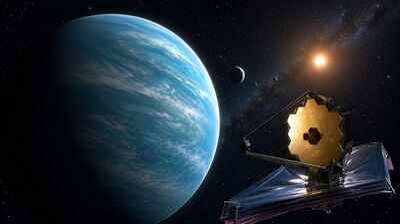
The James Webb Space Telescope has made another remarkable discovery that is reshaping scientists’ understanding of how planetary systems form. By detecting semi-heavy water—also known as deuterated water or “heavy water”—within the icy material surrounding a young star, astronomers have uncovered compelling evidence that water can survive the violent birth of stars and planets. Rather than being created entirely during planet formation, much of the water present in planetary systems may actually be inherited from the cold molecular clouds that existed long before the star itself was born.
This finding addresses one of astronomy’s biggest questions: where does the water on planets like Earth come from? For decades, researchers have debated whether Earth’s oceans formed through chemical reactions after the Solar System emerged or whether water already existed in the vast clouds of gas and dust that collapsed to create the Sun and its planets. Webb’s observations strongly support the second possibility, suggesting that water has a far older cosmic history than previously imagined.
The discovery focuses on semi-heavy water, a rare form of water in which one hydrogen atom is replaced by deuterium, a heavier isotope of hydrogen. Because deuterium forms under extremely cold conditions in interstellar space, it serves as a chemical fingerprint. If scientists detect high levels of this heavy water around newly formed stars, it indicates that the water originated in ancient molecular clouds instead of forming later within the planetary disk. Webb’s sensitive infrared instruments were able to identify this distinctive chemical signature with unprecedented precision.
The observations were made in a young stellar system still surrounded by a dense protoplanetary disk—a rotating disk of gas, dust, and ice where planets are actively taking shape. These disks represent the earliest stages of planetary evolution, making them ideal laboratories for studying the raw materials that eventually become planets, moons, asteroids, and comets. Webb’s ability to peer through thick clouds of dust allowed astronomers to examine regions that were previously hidden from view.
Scientists believe the ratio of heavy water to ordinary water has remained largely unchanged since before the star formed. This means the icy particles observed today may have traveled through multiple stages of cosmic evolution without losing their original chemical identity. Such resilience suggests that water can endure enormous physical changes—from cold interstellar clouds to collapsing stellar nurseries and eventually into newborn planetary systems.
The implications extend far beyond this single star system. If water commonly survives star formation throughout the galaxy, then countless young planetary systems may begin their lives already stocked with one of the essential ingredients for life. Instead of requiring unique or rare conditions, water could be a natural inheritance of the planet-building process itself. This dramatically increases the likelihood that water-rich worlds exist around many other stars in the Milky Way.
The findings also strengthen long-standing theories about the origin of Earth’s oceans. Many researchers believe icy comets and water-rich asteroids delivered additional water to the young Earth during the Solar System’s early history. If those bodies formed from ancient interstellar ice preserved within the solar nebula, then the water we drink today may have existed billions of years before the Sun was even born. In a sense, Earth’s oceans could represent a direct inheritance from the galaxy’s earliest star-forming clouds.
The James Webb Space Telescope continues to demonstrate why it is one of the most powerful scientific observatories ever built. Designed to observe the universe in infrared light, Webb can detect molecules hidden inside dense cosmic dust clouds that previous telescopes could not penetrate. Its extraordinary sensitivity enables astronomers to study the chemistry of planet formation with a level of detail that was unimaginable only a few years ago.
Researchers expect this discovery to be only the beginning. Webb will continue surveying young stars across different regions of the galaxy, comparing their water content and chemical composition. By expanding these observations, astronomers hope to determine whether inherited interstellar water is a universal feature of planet formation or whether some planetary systems follow different evolutionary paths. Each new observation will bring scientists closer to understanding not only how planets form, but also how the ingredients necessary for life become distributed throughout the cosmos.