TSMC Pulls Forward 1.4nm Chip Production as AI Demand Reshapes the Semiconductor Industry
The world's leading chipmaker accelerates its next-generation manufacturing roadmap, aiming to deliver cutting-edge 1.4-nanometer chips earlier than expected as competition in artificial intelligence and high-performance computing intensifies.

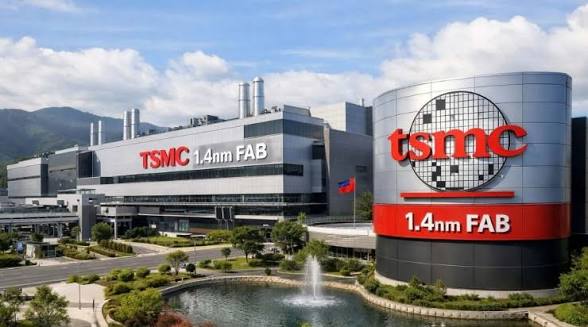
Taiwan Semiconductor Manufacturing Company (TSMC), the world’s largest contract chip manufacturer, is reportedly accelerating the timeline for mass production of its highly anticipated 1.4-nanometer (A14) semiconductor technology. The move reflects the extraordinary demand for advanced chips driven by artificial intelligence, cloud computing, next-generation smartphones, autonomous vehicles, and high-performance computing.
According to industry reports, TSMC is now aiming to begin volume production of its A14 process in 2028, earlier than many analysts had expected. The accelerated schedule demonstrates the company’s confidence in its manufacturing roadmap and highlights how quickly the semiconductor industry is evolving to meet the explosive demand for AI computing power.
The decision comes as AI has become the single biggest growth driver in the global technology sector. Companies such as NVIDIA, Apple, AMD, Qualcomm, Broadcom, and numerous cloud providers continue to require increasingly advanced chips capable of processing enormous AI workloads while consuming less power. Every new generation of semiconductor technology allows engineers to fit more transistors into the same silicon area, improving both performance and energy efficiency.
The A14 manufacturing process represents one of the most advanced semiconductor technologies ever developed. Compared with previous generations, the new node is expected to deliver higher computing performance while significantly reducing power consumption. Early projections indicate performance improvements of roughly 10–15% at similar power levels or substantial energy savings at equivalent performance, making it particularly attractive for AI accelerators, data centers, premium smartphones, and future edge-computing devices.
The accelerated roadmap also reflects the increasingly intense competition among the world’s leading semiconductor manufacturers. TSMC continues to face growing challenges from Samsung Foundry and Intel Foundry Services, both of which are investing tens of billions of dollars into advanced manufacturing technologies. Each company is racing to secure contracts from the world’s biggest chip designers as demand for AI processors continues to soar.
Although TSMC remains the market leader in advanced chip manufacturing, maintaining that leadership requires continuous investment. The company spends tens of billions of dollars annually on research, development, fabrication facilities, and advanced lithography equipment. These investments have enabled TSMC to consistently introduce new manufacturing nodes ahead of many competitors while maintaining exceptionally high production yields.
Another important factor behind the accelerated schedule is the growing importance of advanced packaging technologies. Modern AI processors are becoming so complex that performance improvements no longer come solely from shrinking transistor sizes. Instead, manufacturers increasingly rely on sophisticated packaging methods that combine multiple chips into a single integrated system.
Reports indicate that TSMC is simultaneously expanding development of advanced packaging technologies capable of competing with or surpassing similar innovations introduced by Intel. These packaging solutions allow multiple computing dies, memory chips, and specialized accelerators to operate together with extremely high bandwidth and lower latency, significantly boosting AI performance.
Artificial intelligence has fundamentally transformed semiconductor demand. Unlike traditional computing workloads, AI models require enormous amounts of parallel processing, creating unprecedented demand for advanced GPUs, custom AI accelerators, and high-bandwidth memory. As a result, semiconductor manufacturers are experiencing one of the strongest investment cycles in industry history.
The benefits of more advanced manufacturing extend well beyond data centers. Future smartphones powered by 1.4nm processors are expected to deliver faster on-device AI, longer battery life, improved photography, real-time language translation, enhanced augmented reality experiences, and more capable digital assistants. Laptop computers, autonomous vehicles, robotics, medical devices, and industrial automation systems are also expected to benefit from the increased efficiency of next-generation chips.
TSMC’s accelerated timeline also carries geopolitical significance. The company manufactures advanced chips for many of the world’s largest technology firms and occupies a critical position in the global semiconductor supply chain. Governments across the United States, Europe, Japan, and Asia continue investing heavily in semiconductor production as chips become increasingly important for economic competitiveness, national security, and technological leadership.
To support future production, TSMC is expanding its global manufacturing footprint while continuing to strengthen operations in Taiwan. The company is investing in new fabrication plants in the United States, Japan, and Europe while simultaneously constructing advanced facilities in Taiwan that will support future generations of semiconductor technology. These projects represent some of the largest industrial investments currently underway anywhere in the world.
Industry analysts believe the decision to move forward the A14 production schedule demonstrates both confidence and urgency. AI demand continues to exceed expectations, cloud providers are ordering record numbers of advanced processors, and major technology companies are rapidly expanding their AI infrastructure. Accelerating next-generation manufacturing allows TSMC to meet customer demand while reinforcing its position as the world’s leading supplier of cutting-edge semiconductor technology.
As artificial intelligence continues reshaping industries ranging from healthcare and finance to transportation and scientific research, the importance of advanced chip manufacturing will only continue to grow. Every new semiconductor generation enables more powerful AI models, faster computing, lower energy consumption, and entirely new categories of intelligent devices.
TSMC’s decision to accelerate its 1.4-nanometer roadmap is therefore more than just a manufacturing milestone—it signals the next phase of the global AI revolution. With demand for computing power showing no signs of slowing, the race to build smaller, faster, and more efficient chips is becoming one of the defining technology competitions of the decade, and TSMC intends to remain firmly at the center of it.