NASA Launches $4.3 Billion Roman Space Telescope
NASA’s Nancy Grace Roman Space Telescope has begun its journey into deep space, opening a new chapter in the study of dark matter, dark energy and planets beyond our solar system.

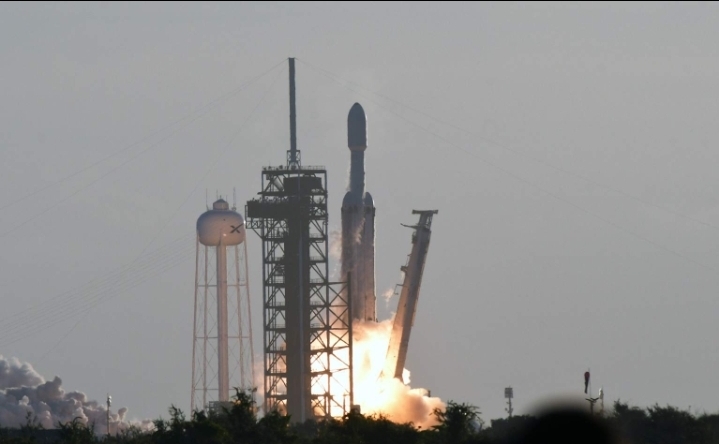
NASA successfully launched the Nancy Grace Roman Space Telescope on August 30, 2026, aboard a SpaceX Falcon Heavy rocket from Kennedy Space Center in Florida. The $4.3 billion observatory is now traveling toward the second Sun-Earth Lagrange point, roughly one million miles from Earth, where it will conduct its primary scientific mission. NASA says the launch took place at 7:26 a.m. EDT and the spacecraft began transmitting telemetry shortly afterward.
Roman is designed to give astronomers an unusually broad view of the universe. Its 300-megapixel Wide Field Instrument will capture enormous infrared panoramas, allowing scientists to survey the sky far faster than the Hubble Space Telescope. NASA says Roman is designed to survey the universe about 1,000 times faster than Hubble, while maintaining sharp infrared imaging.
One of its biggest missions is to investigate dark matter and dark energy, two poorly understood components that play major roles in the structure and expansion of the universe. Roman will also search for and study exoplanets, helping scientists understand how planetary systems form and evolve. Its Coronagraph Instrument will test technology for directly imaging planets around other stars, potentially laying groundwork for future missions searching for Earth-like worlds.
The telescope has an unusual history. Its primary mirror is based on a Hubble-sized optical system originally developed for the U.S. intelligence community and later provided to NASA. Roman’s wide-field design will complement rather than replace Hubble and the James Webb Space Telescope: Webb specializes in detailed observations of relatively small areas, while Roman is designed to rapidly survey huge portions of the sky.
Roman is expected to spend about three months traveling to and commissioning at its final orbit, with NASA anticipating its first images in early 2027. Once fully operational, the observatory is expected to transmit around 1.4 terabytes of data every day, creating an enormous scientific dataset for astronomers and researchers. Its primary mission is planned for at least five years, with the possibility of an extension.