
Toyota Expands Humanoid Robot Research as Automakers Race to Automate Factories
Toyota is accelerating its robotics ambitions through artificial intelligence, humanoid robot research and factory automation as global automakers compete to improve productivity and address labour shortages.

Toyota is strengthening its position in the rapidly developing robotics industry as it explores how artificial intelligence can help humanoid robots perform practical tasks in real-world environments. The Japanese automaker has been researching robots for years, but its latest efforts reflect a broader shift towards machines that can learn, adapt and work alongside people. According to Toyota’s published research, its Frontier Research Center is developing AI-based control systems that could make humanoid robots more useful in everyday industrial and social settings. The company is investigating how robots can learn movements through reinforcement learning, a machine-learning technique in which systems improve their behaviour through repeated attempts and feedback.
One important area of Toyota’s research involves teaching robots to perform physical movements through simulated environments before testing their abilities on real machines. Researchers have explored tasks such as walking and basketball dribbling, using simulations to help robots learn balance, movement and coordination. Thousands of simulated robot instances can operate in parallel during training, allowing the system to learn more quickly than through physical testing alone. Toyota is also studying how to account for real-world challenges, including camera errors, delays and changes in the surrounding environment. These developments could eventually help robots perform more complicated activities without requiring engineers to program every individual movement manually.
Toyota’s robotics ambitions also extend beyond research laboratories. In September 2026, Reuters reported that the company was considering factory-automation investment of approximately ¥1 trillion, or $6.4 billion, annually from 2028. The broader programme could involve around 400,000 robots across Toyota, its group companies and major suppliers. However, this figure includes both conventional industrial robots and other automation equipment; it should not be interpreted as a confirmed target for 400,000 humanoid robots alone. The proposed investment reflects Toyota’s interest in modernising manufacturing operations, improving efficiency and addressing workforce challenges. The company has not established that the entire estimated investment will definitely proceed or specified how long the spending would continue.
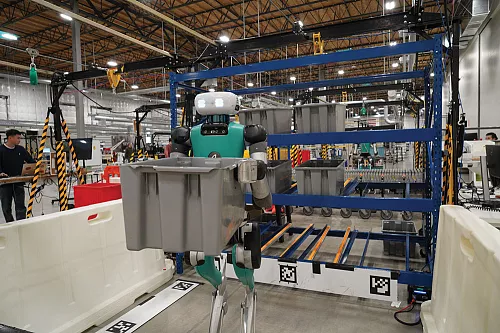
Toyota is entering an increasingly competitive market in which automakers and robotics companies are developing machines capable of carrying out tasks traditionally performed by people. Tesla is pursuing its Optimus humanoid robot, while Hyundai is preparing to introduce robots developed by Boston Dynamics into manufacturing operations. Toyota is also exploring partnerships and new approaches to robot learning, building on its long experience with industrial automation. In Canada, Toyota’s manufacturing operations have been reported to be using humanoid robots supplied by Agility Robotics to move containers of components around factory environments. Such applications demonstrate why manufacturers are interested in robots that can navigate workplaces and handle materials, although the technology still faces limitations involving reliability, safety, cost and performance.
Despite the growing investment, the future of humanoid robotics will depend on whether these machines can deliver measurable benefits outside demonstrations and controlled testing environments. Robots must be able to perform tasks consistently, operate safely near employees and justify their costs compared with existing automation systems or human labour. Toyota has emphasised a human-centred approach to robotics, describing a vision in which technology supports people rather than simply replacing them. If its research succeeds, AI-powered robots could help manufacturers handle repetitive physical work, improve production processes and respond to labour shortages. For now, Toyota’s progress represents part of a wider industrial transformation, with the long-term commercial impact depending on how effectively robotics research can be translated into dependable, affordable systems.




