
Nvidia’s Jensen Huang Rejects Geoffrey Hinton’s AI Doomsday Warning
Nvidia CEO Jensen Huang has challenged Geoffrey Hinton’s estimate of the risk of AI causing societal collapse, arguing that such predictions are not sufficiently supported by scientific evidence.

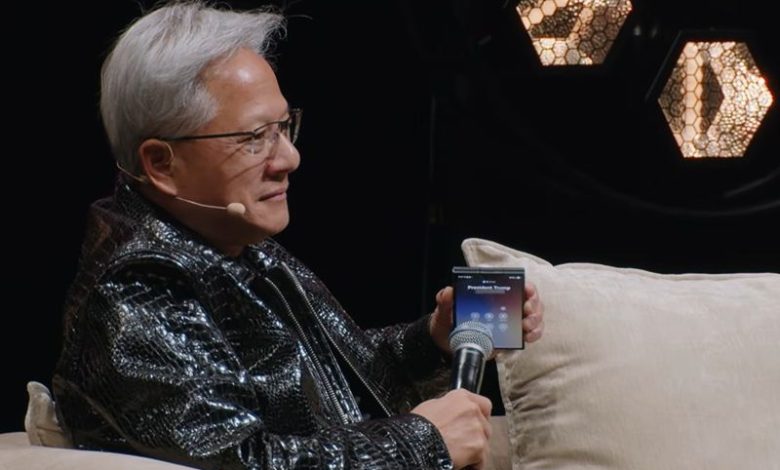
Nvidia CEO Jensen Huang has pushed back against warnings from AI pioneer Geoffrey Hinton about the potential dangers of increasingly powerful artificial intelligence. During a recent interview with New York Times podcast host Ezra Klein, Huang questioned Hinton’s estimate that there is a 10 to 20 percent chance that AI could eventually cause societal collapse. Huang argued that the probability was not grounded in scientific research.
Hinton, one of the researchers widely regarded as a pioneer of modern artificial intelligence, has previously warned that advanced AI could create risks that humanity may struggle to control. Huang, however, said predictions assigning precise probabilities to such catastrophic outcomes should be treated cautiously because there is not enough evidence to calculate them with confidence. Hinton himself has acknowledged that his percentage estimate is essentially a “wild guess” because the available evidence is limited.
Huang has increasingly become one of the prominent technology executives arguing against what he considers excessive AI doomsday predictions. He has said that AI is likely to produce significant benefits for society and has questioned whether alarmist warnings could discourage young people from pursuing education and careers because of fears that AI will eliminate large numbers of jobs. His position contrasts with several AI leaders and researchers who have called for stronger safeguards as AI systems become more capable.
The disagreement comes amid a wider debate about how quickly AI development should proceed and what safeguards should accompany it. Anthropic CEO Dario Amodei and other technology figures have argued for stronger safety measures and, in some cases, greater coordination around frontier AI development. Huang has instead maintained that existing legal responsibilities, product liability rules and company-led safety testing should play a central role.
Huang has nevertheless said that AI companies should not receive exemptions from existing antitrust or product-liability laws. He has also acknowledged that specific AI applications, such as autonomous vehicles, may require additional regulation where existing rules are insufficient. The contrasting positions among major figures in the technology industry show that debate over AI safety is increasingly focused not only on the technology’s potential benefits, but also on how its risks should be measured and managed.




