
Canadian Telescope Detects Ancient Hydrogen Glow From the Early Universe
The CHIME radio telescope has detected faint hydrogen emission from billions of years ago using only its own observations, opening a new way to study cosmic expansion and dark energy.

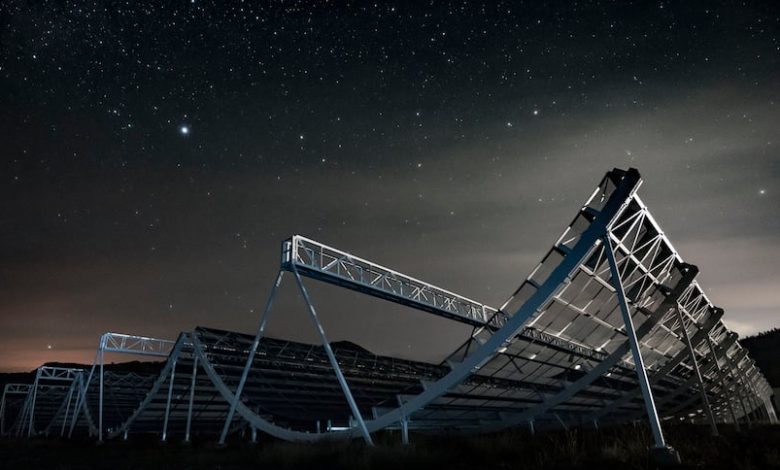
Astronomers using Canada’s Canadian Hydrogen Intensity Mapping Experiment (CHIME) have achieved a significant milestone by detecting the faint radio glow of ancient hydrogen using only data collected by the telescope itself. The observation provides a new method for studying how matter was distributed in the distant universe and how the universe has expanded over cosmic time. The findings were published in The Astrophysical Journal.
The signal comes from hydrogen gas dating to a period when the universe was roughly five billion years old, according to the University of British Columbia, which is part of the CHIME collaboration. Hydrogen is the most abundant element in the universe, and its radio emission can act as a tracer of how matter is distributed across enormous regions of space. By mapping this emission, scientists can study the history of cosmic expansion.
What makes the result particularly important is that CHIME detected the hydrogen signal through its own radio observations rather than relying on galaxy maps from other telescopes. Previously, researchers often combined hydrogen measurements with external galaxy surveys to identify and interpret the extremely faint signal. The new approach, known as autocorrelation, could allow scientists to examine much larger areas of the universe at lower cost and without depending on additional surveys.
The discovery was not immediate. Researchers analyzed 94 nights of observations collected in 2019 and spent more than a year testing the result against background noise from the universe, human technology and the telescope itself. The team concluded that the signal remained after extensive checks. Their analysis also indicated that roughly 2% of the hydrogen at the period observed was in neutral atomic form, broadly consistent with other measurements.
Scientists say the technique could eventually provide a powerful new way to investigate dark energy, the poorly understood phenomenon associated with the accelerating expansion of the universe. CHIME has already collected nearly seven years of observations, and researchers plan to use more of that data to look further back in cosmic history. The new detection therefore represents not only a measurement of ancient hydrogen, but also a potential new tool for studying some of the biggest unanswered questions in modern cosmology.




