CERN Detects Quantum Entanglement in Particles From Higgs Bosons
Physicists at CERN Find Strong Evidence of Quantum Entanglement Between Short-Lived Z Bosons Produced in Higgs Boson Decays.

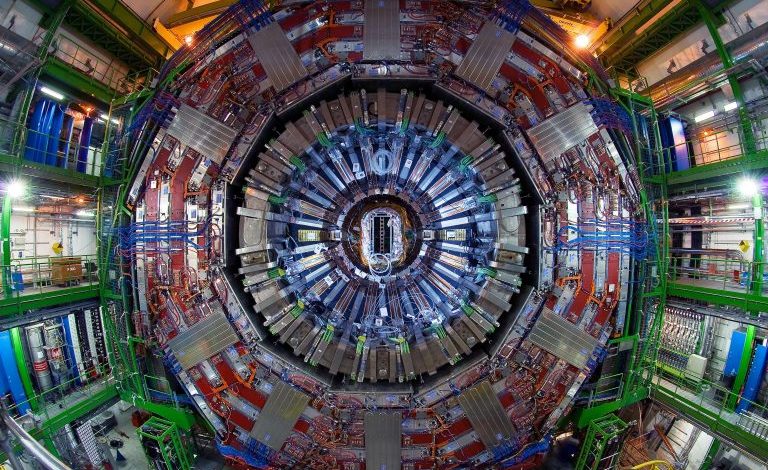
Scientists working with the ATLAS experiment at CERN’s Large Hadron Collider have found evidence that quantum entanglement can occur between pairs of extremely short-lived Z bosons produced through Higgs boson decays. The result provides another demonstration that quantum mechanical effects persist even in the high-energy environment of particle collisions.
Quantum entanglement is a phenomenon in which the properties of two particles become correlated in a way that cannot be fully explained by treating the particles independently. It has been extensively studied in quantum physics, but observing such behaviour in heavy and unstable particles provides scientists with a new environment for testing the foundations of quantum theory.
The ATLAS researchers used collisions inside the Large Hadron Collider to study the behaviour of Z bosons created in processes involving the Higgs boson. Because these particles exist for an extremely short period before transforming into other particles, detecting their quantum correlations requires sophisticated measurements and statistical analysis.
The finding is important because it extends studies of entanglement into an energy regime far beyond the systems normally associated with quantum experiments. Scientists can use these observations to investigate how quantum information and fundamental particles behave under extreme conditions, potentially providing new tests of the theories that describe the microscopic universe.
The result does not mean that scientists have discovered a new form of communication or overturned established physics. Instead, it strengthens evidence that quantum mechanics continues to describe particle behaviour even at the enormous energies reached by the LHC. Researchers expect further measurements to help determine how these quantum effects can be studied with greater precision in future experiments.