China Produces 95% of the World’s Humanoid Robots
China is rapidly expanding its humanoid-robot industry, combining large-scale manufacturing, government support and a growing ecosystem of robotics companies—but commercial deployment remains a major challenge.

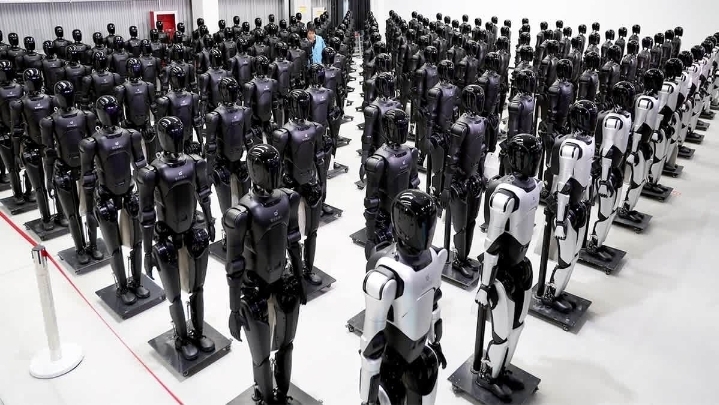
China has emerged as the dominant manufacturing center for humanoid robots. According to a Reuters investigation published August 27, Chinese manufacturers accounted for approximately 95% of the roughly 20,000 humanoid robots shipped worldwide in 2025. The figure highlights the country’s enormous manufacturing advantage as companies race to develop robots capable of operating in factories, warehouses and other real-world environments.
Government support has played an important role in this rapid expansion. Reuters reports that Chinese humanoid-robot companies received more than $230 million in government subsidies during the first half of 2026 alone. China is using a strategy similar to its earlier development of electric vehicles and solar technology: encourage large-scale production, promote competition between manufacturers and drive down costs through manufacturing efficiency.
But producing large numbers of robots does not necessarily mean the technology is ready to replace human workers. Many current humanoids still struggle with speed, reliability and adapting to unexpected situations. Robots can perform impressive demonstrations under controlled conditions, but messy environments such as warehouses and factories require machines to recognize changing circumstances and respond appropriately. Analysts therefore expect the industry to undergo significant consolidation as companies discover which products can actually generate sustainable commercial demand.
China’s advantage extends beyond final robot assembly. The country has a huge manufacturing ecosystem capable of producing motors, batteries, sensors and other components at relatively low cost. This gives Chinese robotics companies an important advantage as they attempt to move from prototypes toward mass production. The country’s enormous industrial base also creates opportunities to collect the physical-world data needed to train embodied AI systems—the technology that allows robots to understand their surroundings and translate AI decisions into physical movement.
The next challenge is turning manufacturing dominance into useful, commercially viable robots. China has already demonstrated rapid progress, including humanoids setting remarkable athletic records at the 2026 World Humanoid Robot Games. Yet experts emphasize that practical abilities—such as manipulating objects, navigating unpredictable environments and completing useful industrial tasks—matter more than speed demonstrations. If Chinese companies solve those problems while maintaining their manufacturing advantage, China could become the leading global hub for humanoid robotics and embodied AI.