Dyna Robotics Unveils DYNA-2 AI Model Trained on 1 Million Hours of Human Video
The robotics startup says its new foundation model learns physical tasks from more than one million hours of first-person human video, opening a new approach to training robots for real-world work.

Dyna Robotics has unveiled DYNA-2, a new robot foundation model designed to improve how machines learn physical tasks. The model was reportedly trained on more than one million hours of first-person human video, equivalent to roughly 170 years of continuous waking experience. Instead of relying primarily on scarce robot-generated training data, DYNA-2 learns from videos showing humans interacting with objects and performing everyday activities.
The approach addresses one of the biggest challenges in robotics: collecting enough high-quality data from physical robots. Training robots traditionally requires large amounts of real-world robot data, which can be expensive and time-consuming to gather. By using human video, Dyna Robotics is attempting to create a much larger source of information about how physical tasks are performed, potentially allowing robots to learn more efficiently.
Dyna Robotics says DYNA-2 demonstrates a new scaling relationship between human video data and robot performance. The company claims that increasing the amount of human video used for training can produce corresponding improvements in robotic capabilities. If independently validated, this could represent an important development for physical AI, where artificial intelligence systems are designed to understand the physical world and perform actions within it.
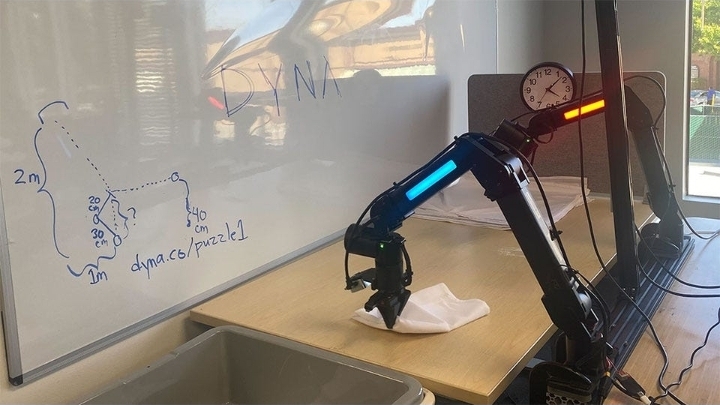
The new model builds on Dyna Robotics’ earlier DYNA-1 system, which was designed for sustained autonomous manipulation using robotic arms. DYNA-1 demonstrated the ability to perform repetitive tasks for extended periods, including a reported 24-hour napkin-folding test with a success rate above 99%. The company has since raised substantial funding to develop more capable foundation models and deploy robots in commercial environments.
DYNA-2 could ultimately help accelerate the development of more adaptable robots capable of working in warehouses, manufacturing facilities, hospitality and other environments. The broader significance is that robotics may increasingly follow the same data-scaling strategy that transformed language and generative AI: collect enormous datasets, train increasingly capable foundation models and use them across many different tasks. If Dyna’s approach proves effective at scale, human video could become an important source of training data for the next generation of physical AI.