Finland’s radical answer to renewable energy’s biggest headache: The world’s largest sand battery
The industrial-scale sand battery in Finland’s Pornainen can cover almost one month of the town’s heating demands in the summer and as much as one week in the winter.

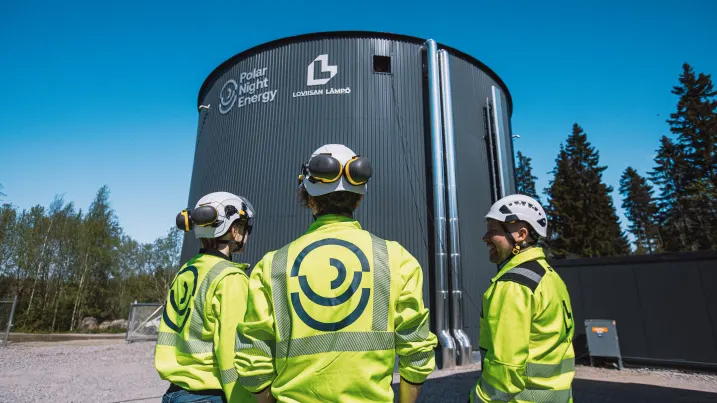
How Finland’s giant sand battery is helping solve renewable energy’s biggest challenge
A small town in southern Finland has switched on the world’s largest commercial sand battery in a bid to tackle one of renewable energy’s biggest obstacles: storing power for when the sun isn’t shining and the wind isn’t blowing.
The towering facility, measuring 13 metres high and 15 metres wide, stores excess renewable electricity as heat using 2,000 metric tonnes of crushed soapstone. It can hold up to 100 megawatt-hours of thermal energy, enough to meet the summer heating needs of Pornainen’s 5,000 residents for nearly a month, or about a week during winter.The project, developed by Polar Night Energy and operated by district heating company Loviisan Lämpö, was launched last year to provide a more flexible, low-carbon heating system for the town.
According to Polar Night Energy, the installation has cut greenhouse gas emissions from the local heating network by nearly 70% while reducing wood-chip consumption by around 60%. A wood-chip power plant remains available to provide backup power during periods of peak demand.
Polar Night Energy CEO Tommi Eronen said Pornainen previously relied on oil and wood chips for heating but now uses combustion-free heating for most of the year.
He said the growing use of wind and solar power makes large-scale energy storage increasingly important, adding that sand batteries offer an alternative to lithium-ion batteries because they do not require rare earth materials.
The new installation is roughly 10 times larger than the company’s first sand battery launched in Finland in 2022, highlighting the technology’s growing potential to reduce emissions in Finland and elsewhere.
Despite the promise of sand batteries for storing heat over long periods, experts note that challenges remain. These include efficiently converting stored heat back into electricity and their lower energy density compared with conventional battery technologies.
How the sand battery works
The system works by storing heat rather than electricity. When renewable electricity is abundant and inexpensive, it is used to heat the crushed soapstone to very high temperatures inside a heavily insulated storage silo.
The stored heat can remain trapped for days or even weeks before being released through heat exchangers to warm water that supplies the town’s district heating network.
Polar Night Energy’s Chief Commercial Officer, Annette Höglund-Dönnes, said the ability to store heat when electricity prices are low and use it later when energy is more expensive is the technology’s key advantage. She compared the process to charging a mobile phone overnight when electricity is cheaper.
Höglund-Dönnes said the company has received interest from organisations on every continent, particularly from regions looking to replace fossil fuel-based heating systems.
Scientists have consistently warned that reducing the use of coal, oil and natural gas is essential to slowing climate change, making renewable energy storage technologies increasingly important.
Jan Rosenow, Professor of Energy and Climate Policy at the University of Oxford, said electrothermal storage systems such as sand batteries are likely to become more common worldwide because they avoid the need for critical raw materials and can store energy for days or even weeks, unlike many lithium-ion batteries that typically provide only a few hours of storage.