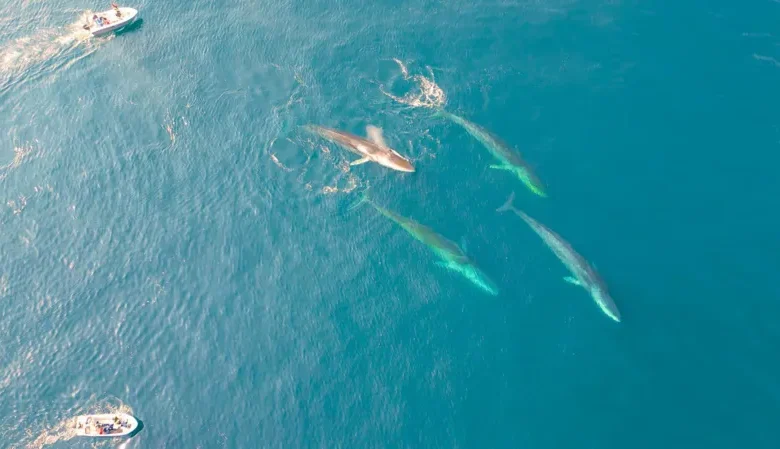
Sea ice has been disappearing from East Greenland, allowing giant whales to take advantage and move in to previously inaccessible areas.
That is the conclusion of a decades-long study that has recorded – and filmed – hundreds of the world’s biggest whales including humpbacks, minke and fin whales, feeding in ice-free seas along the coast in summer.
None of these marine mammals were historically found here as they have been locked out of the coastal waters by ice. Now, as climate change warms the sea and melts that ice, they have adapted.
Scientists describe the result as seasonal Arctic “feeding frenzies” – part of a major regime shift in the ocean environment along East Greenland.
The change is dramatic: ship-based surveys in the region did not record a single humpback whale sighting there until 2006.
In 2007, seven humpbacks were seen, and by 2024, there were 150 ship-based sightings of these giant whales.
The first systematic aerial surveys of baleen whales – a group that includes fin, minke and humpbacks – off the East Greenland coast were carried out by the researchers during the summers of 2015 and 2024.
They combined that information with the tracks of 15 satellite-tagged whales and testimony from Inuit hunters – all building a picture of what the lead researcher Prof Mads Peter Heide-Jørgensen called a “major ecological regime shift”.
An estimated 4,000 humpback whales, 6,000 fin whales and 6,000 minke whales visited the Greenland Sea in the summer of 2024.