
Japan Launches MMX Mission to Explore Mars’ Mysterious Moons
Japan has launched its Martian Moons eXploration mission to investigate Phobos and collect samples for return to Earth, aiming to uncover the origins of Mars’ mysterious moons and improve scientific understanding of the Red Planet.

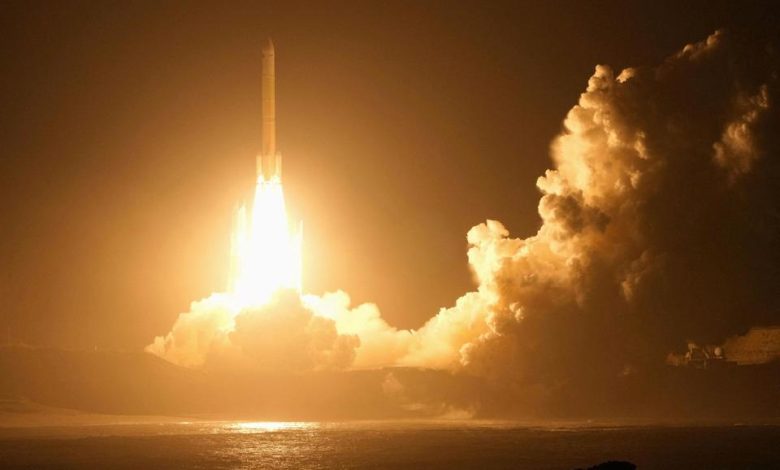
Japan has launched its Martian Moons eXploration (MMX) spacecraft, beginning an ambitious mission to study the two moons of Mars and return samples of material from Phobos to Earth. The spacecraft lifted off aboard Japan’s H3 rocket from the Tanegashima Space Center, marking an important milestone for the Japan Aerospace Exploration Agency (JAXA). The mission is designed to travel to the Martian system, examine Phobos and Deimos, and collect samples from Phobos before returning them to Earth. If successful, MMX would achieve a major scientific first by bringing material from a Martian moon back to terrestrial laboratories. The mission builds on Japan’s previous experience with asteroid sample-return projects and extends the country’s role in international planetary exploration.
One of the central questions MMX aims to answer is how Mars acquired its two small moons. Phobos and Deimos have long puzzled scientists because their origins remain uncertain. One theory suggests that they are asteroids captured by Mars’ gravitational pull, while another proposes that they formed from debris created by a massive collision involving the planet. Analysing samples from Phobos could help researchers determine which explanation is more likely. The material may preserve chemical and mineralogical evidence that has not been significantly altered by the processes affecting larger planetary bodies. Understanding the moons’ origins could also provide new information about the early history of Mars and the wider Solar System.
The mission will use a combination of remote sensing instruments and surface operations to study Phobos. Its scientific equipment includes spectrometers, laser instruments and radiation monitors designed to analyse the moon’s composition and environment. MMX will also carry Idéfix, a small rover developed with contributions from French and German space agencies. The rover is expected to examine the surface and provide information that can help scientists understand the terrain before the spacecraft attempts sample collection. Operating on Phobos presents significant technical challenges because the moon has extremely weak gravity and an unfamiliar surface. Engineers must carefully control the spacecraft’s movements to avoid bouncing away from the surface or disturbing the material they intend to collect.
Japan’s mission is part of a broader international effort to investigate Mars and its surrounding environment. NASA and the European Space Agency are contributing to aspects of the project, including scientific cooperation and technical support. The mission is expected to take approximately five years, with the sample-return phase planned for around 2031. Its findings could complement research by NASA’s Perseverance rover, which has been collecting Martian rock samples that remain on the planet. While MMX will not directly return samples from Mars itself, material from Phobos could help scientists investigate whether the moon contains substances originating from the Martian surface. Such evidence could provide additional clues about the geological history of Mars and the processes that shaped its moons.
The success of MMX could strengthen Japan’s reputation in planetary exploration and provide valuable experience for future sample-return missions. Returning material from another celestial body requires precise navigation, reliable spacecraft systems and a carefully controlled journey back to Earth. Scientists will then be able to study the collected material using laboratory equipment that cannot be carried aboard a spacecraft. Although the mission will take years to complete, its potential scientific value is considerable. A successful return could help settle longstanding questions about Phobos and Deimos, improve understanding of Mars’ early environment and support the planning of future robotic and human exploration. For now, researchers will focus on the spacecraft’s journey to the Martian system and the complex operations that lie ahead on it.




