Nearly 1,000 Arrested as Fresh Clashes Follow Mass Protests Across France
Hundreds of thousands of people took to the streets over the cost of living and poor school conditions, with police deploying tear gas and water cannon as violence erupted in several cities.

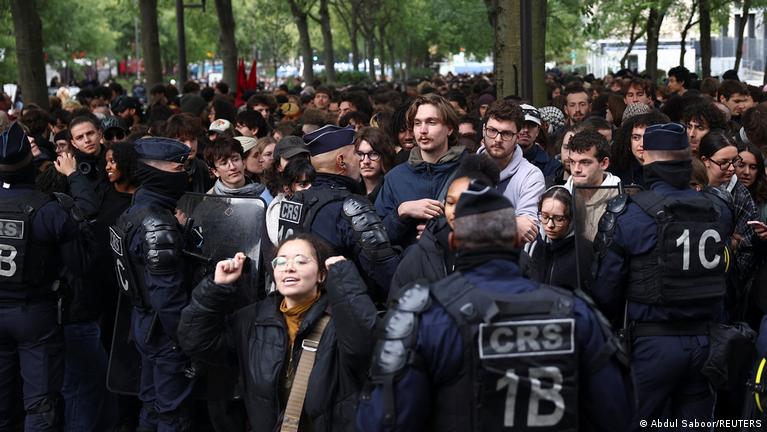
Nearly 1,000 people were arrested across France on Saturday, October 24, 2026, after mass demonstrations over the rising cost of living and poor school conditions were followed by clashes between protesters and security forces.
The French Interior Ministry estimated that 410,000 people participated in the demonstrations, while trade unions put attendance at approximately 800,000.
Although most marches remained peaceful during the day, confrontations broke out later in Paris, Marseille, Bordeaux and Lyon. Police used tear gas, water cannon and baton charges to disperse groups accused of attacking officers and damaging property.
Authorities said the scale of disorder remained below that of the previous weekend, when widespread looting, arson and vandalism affected businesses and public buildings across the country.
About 70,000 police officers were deployed nationwide as authorities introduced restrictions in several cities to prevent further violence.
President Emmanuel Macron had earlier announced that only demonstrations organised by recognised trade unions would be permitted.
Interior Minister Laurent Nuñez said several thousand radical activists had gathered towards the rear of the Paris march, including approximately 500 people identified by authorities as rioters.
Police confronted masked demonstrators who allegedly threw projectiles, erected barricades and smashed windows at a car dealership.
Nuñez also reported that two people had sustained serious injuries, one in Toulouse in southwestern France and another in Clermont-Ferrand in central France.
In Marseille, protesters set rubbish bins on fire and erected makeshift barricades using metal sheets and other materials. A law enforcement vehicle was seen driving through a burning barricade.
In Bordeaux, some demonstrators reportedly removed boards from a building to construct street barricades, while objects were set alight during confrontations with police.
Police in Lyon deployed tear gas to disperse a crowd gathered in an area designated as off-limits by local authorities.
One protester in Lyon told the BBC that the police response came almost immediately after the gathering began, leaving demonstrators struggling to see through the tear gas.
The demonstrations reflect growing frustration among sections of the French population over living costs, taxation, education and the government’s response to public concerns.
A 26-year-old protester in Paris, identified as Zelie, told the BBC that people were tired of what she described as excessive taxation and restrictions on their ability to express dissatisfaction.
Two masked teenage demonstrators said young people felt abandoned by the government. One condemned looting but argued that poverty and police violence had contributed to the unrest.
The protesters said the demonstrations would continue until the government responded to their demands.
The latest demonstrations followed protests the previous weekend that drew approximately 550,000 people, according to the report.
The unrest that followed resulted in more than 2,500 arrests and damage to more than 2,000 shops and other businesses, according to figures cited by France’s Chambers of Commerce and Industry.
The economic losses were estimated at hundreds of millions of euros.
The earlier violence also left about 1,000 police officers injured, while one demonstrator reportedly lost a hand after a crowd-control grenade exploded.
Authorities subsequently imposed overnight curfews in Paris and other cities.
Demonstrations and clashes were also reported elsewhere in Europe on Saturday.
In Barcelona, more than 100 people were arrested after a student protest descended into what local authorities described as gratuitous violence.
In Albania’s capital, Tirana, riot police used tear gas to disperse anti-government demonstrators, while clashes were reported in Brussels, Belgium.
In Milan, Italy, a major security operation involving police and hundreds of soldiers prevented protesters from gathering, amid concerns about a repeat of the previous weekend’s violence.
Meanwhile, approximately 13,000 people attended a peaceful rally against the far-right National Rally party in Orléans, north-central France.
The continuing protests come six months before France’s presidential election, with political contenders blaming Macron and his administration for the country’s mounting social tensions.
Hundreds of people have already been jailed following fast-track court hearings over offences including vandalism, arson and looting during previous demonstrations.
With protesters demanding changes to government policies and authorities seeking to prevent further destruction, the unrest presents an ongoing challenge for France ahead of the election campaign.