Nvidia Begins Mass Production of Next-Generation AI Chips as Global Demand Reaches Record Levels
The AI chip leader says mass production of its latest processors is now underway, marking a major milestone as technology companies worldwide race to build the infrastructure powering the next generation of artificial intelligence.

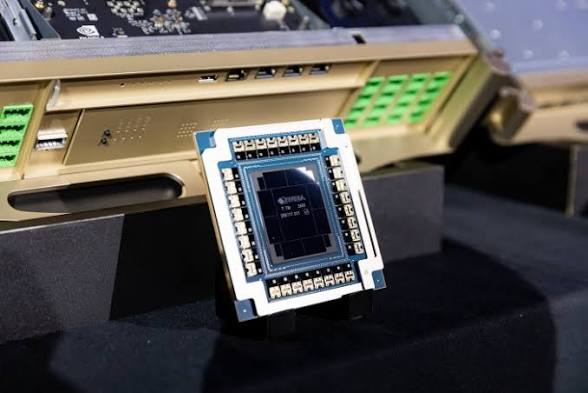
Nvidia has announced that it has officially begun mass production of its latest generation of artificial intelligence chips, marking another major milestone in the global AI race. The move comes as demand for AI hardware continues to exceed supply, with cloud providers, technology giants, governments, and enterprises investing hundreds of billions of dollars in AI infrastructure. By ramping up production, Nvidia aims to meet the growing appetite for advanced processors that power everything from large language models and autonomous AI agents to robotics, scientific research, and cloud computing platforms. The company says the production milestone reflects its confidence in the maturity of its newest chip architecture and its ability to support the next wave of AI innovation.
The latest chips are expected to play a central role in training and running increasingly sophisticated AI models. Unlike traditional processors, Nvidia’s AI accelerators are specifically designed to handle the massive parallel computations required by modern machine learning systems. These processors combine high-performance graphics processing units (GPUs), advanced memory technologies, ultra-fast networking, and optimized software to dramatically reduce the time required to train large AI models while improving efficiency during inference—the stage where AI systems generate responses for users. As organizations deploy AI across healthcare, finance, manufacturing, education, scientific research, and enterprise software, demand for these specialized processors has grown at an unprecedented pace. Industry analysts believe the rapid expansion of AI applications will keep demand elevated for years to come, making advanced semiconductor manufacturing one of the world’s most strategically important industries.
Mass production also represents a significant achievement for Nvidia’s manufacturing ecosystem. Producing advanced AI processors requires collaboration across an exceptionally complex global supply chain involving cutting-edge semiconductor fabrication, high-bandwidth memory, advanced chip packaging, testing, and assembly. Manufacturing partners such as TSMC, along with packaging and testing specialists, play critical roles in bringing Nvidia’s designs to market. Expanding production capacity is particularly challenging because AI chips are among the most sophisticated electronic devices ever manufactured, containing tens of billions of transistors built using advanced process technologies measured in just a few nanometers. Despite ongoing investments in new fabrication plants and packaging facilities, demand for AI hardware has consistently outpaced supply, leading to long customer wait times and intense competition among major cloud providers for access to the newest chips. Nvidia’s production ramp therefore represents an important step toward easing supply constraints, even though analysts expect demand to remain exceptionally strong.
The beginning of mass production underscores how artificial intelligence has become one of the defining technologies of the modern economy. Every major technology company is expanding its AI capabilities, while governments are investing heavily in national AI infrastructure to strengthen scientific research, economic competitiveness, and technological leadership. Nvidia’s latest production milestone positions the company to remain at the center of this transformation, supplying the computing power that enables generative AI, autonomous systems, advanced robotics, digital twins, climate modeling, and countless future applications. As AI models continue becoming larger, faster, and more capable, the demand for increasingly powerful processors is expected to grow alongside them. Nvidia’s decision to move into full-scale production therefore represents more than a manufacturing update—it signals that the next phase of the global AI revolution is already underway, supported by a rapidly expanding supply of the hardware that makes modern artificial intelligence possible.