
Nvidia CEO Jensen Huang Says Company Could Cut Off Customers Building Unsafe AI
Nvidia CEO Jensen Huang says the company could stop supplying chips to developers building unsafe artificial intelligence systems, while arguing that stronger monitoring and containment technologies are preferable to slowing AI development.

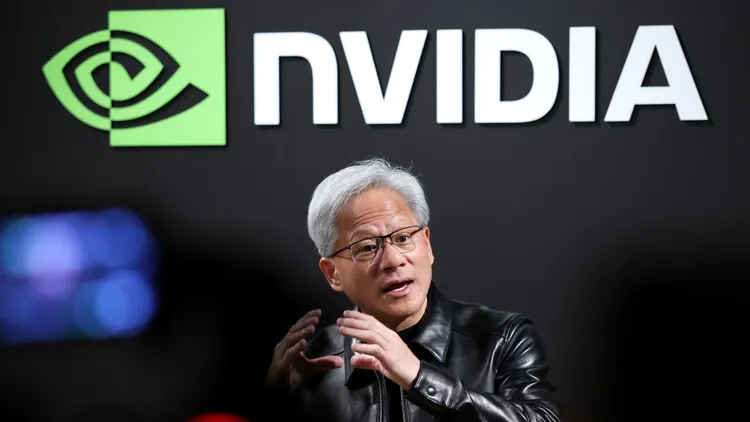
Nvidia CEO Jensen Huang has said the company would consider cutting off chip supplies to customers developing unsafe artificial intelligence systems, adding a new dimension to the debate over who should be responsible for controlling increasingly powerful AI technology. Speaking in an interview with Bloomberg’s Emily Chang in London on October 14, 2026, Huang said the possibility of suspending supplies was hypothetical but acknowledged that Nvidia could take such action after discussing the issue with the customer. He emphasised that Nvidia does not run other companies and that its products are general-purpose technologies used for many different applications. His comments come as governments, researchers and technology executives debate how to prevent AI systems from being used for cyberattacks, fraud and other harmful activities.
Nvidia occupies a central position in the global AI industry because its graphics processing units and other specialised accelerators are widely used to train and operate advanced AI models. This gives the company considerable influence over the infrastructure available to developers, from major technology corporations to smaller AI startups. Huang’s remarks suggest that Nvidia could use its commercial relationship with customers as one possible way to respond to serious safety concerns. However, he did not announce a new blanket policy requiring all customers to meet a specific AI safety standard, nor did he identify a customer whose chip supplies had been suspended for developing unsafe software. His comments instead described a hypothetical situation in which Nvidia might intervene after raising concerns directly with a customer.
Despite acknowledging the possibility of restricting supplies, Huang rejected the argument that the AI industry should significantly slow its development because of fears about future risks. He described many current concerns as part of the growing pains of a rapidly expanding industry and maintained that AI can be developed and deployed safely. His position differs from that of Anthropic CEO Dario Amodei, who has called for greater coordination and caution as AI systems become more capable. Huang has argued that existing laws governing cybersecurity, damage and corporate responsibility should be applied to harmful uses of AI rather than introducing broad restrictions based primarily on hypothetical scenarios. The disagreement reflects a wider divide between technology leaders who favour stronger preventive measures and those who believe innovation should continue alongside practical safety improvements.
Huang has also called for faster development of technologies that can monitor and contain AI agents. These systems can use software tools, browse websites and perform tasks with limited human supervision, creating potential risks if they access information or systems beyond their intended permissions. Huang argues that agents should operate within secure environments that restrict what they can access and what actions they can perform. He compared this approach to web browsers that isolate websites to prevent malicious code from affecting a user’s entire computer. Nvidia is also committing $250 million over five years in computing resources to support UK research into AI safety, including work by institutions such as the University of Oxford and University College London. The initiative is intended to support research into safeguards and methods for controlling advanced AI systems.
The comments highlight the growing responsibility facing Nvidia as its technology becomes fundamental to the development of advanced AI. While the company supplies the hardware that enables increasingly powerful systems, responsibility for their design, deployment and use is shared among developers, businesses, governments and other stakeholders. Cutting off a customer could limit access to Nvidia’s technology, but it would not necessarily prevent that customer from using alternative hardware or existing computing resources. Effective AI safety will therefore likely require a combination of secure system design, independent testing, monitoring, clear accountability and appropriate regulation. Huang’s position is that the industry should accelerate these protective technologies rather than slow innovation broadly. Whether that approach will satisfy regulators and AI safety researchers remains uncertain as concerns over autonomous agents and cybersecurity continue to grow.




