
Nvidia Secures Bolt and Volvo Partnerships to Accelerate Self-Driving Cars
Nvidia is expanding its autonomous-driving business through new partnerships with Bolt, Volvo Cars and other European mobility companies, using advanced AI software and computing platforms to develop safer self-driving vehicles and future robotaxi services.

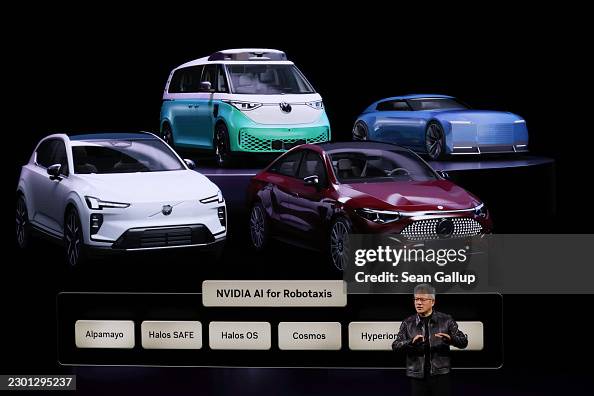
Nvidia has announced a series of partnerships with European automakers and mobility companies to accelerate the development of autonomous vehicles, including robotaxis and self-driving commercial vehicles. The announcement was made on October 21, 2026, during Nvidia’s GTC Berlin event, where the company presented new applications for its Hyperion autonomous-driving platform. Among the key developments, ride-hailing company Bolt selected Nvidia’s Alpamayo software stack for its planned European robotaxi programme, while Volvo Cars is adopting Nvidia’s technology to support automated driving in future vehicles. The partnerships demonstrate Nvidia’s ambition to expand beyond supplying AI chips for data centres and establish itself as a major provider of the computing systems, software and safety tools needed to power autonomous transportation.
Bolt plans to work with Nvidia to develop robotaxi services using future vehicles supplied by Lucid Motors. The companies intend to adapt Nvidia’s autonomous-driving software to European road conditions and integrate it into vehicles from multiple manufacturers. According to Nvidia, Bolt plans to begin collecting real-world driving data in Madrid in 2027, subject to regulatory approval, with Germany identified as another priority market. The broader programme is associated with plans for at least 25,000 future Lucid vehicles capable of Level 4 autonomy, a classification that allows vehicles to operate without human intervention within defined operating conditions. Bolt will contribute its ride-hailing platform, fleet-management systems and local operational expertise, while Nvidia supplies the computing architecture and AI software needed to develop and validate the driving technology.
Volvo Cars is also expanding its relationship with Nvidia, combining the chipmaker’s Hyperion sensor and computing architecture with its Alpamayo autonomous-driving software and Halos safety systems. Volvo intends to use the technology in a next-generation vehicle designed to navigate complex environments, including motorways, urban streets and parking areas. The companies say the system will build on Volvo’s long-standing emphasis on vehicle safety and Nvidia’s expertise in accelerated computing and AI. The technology is expected to be introduced gradually, with Volvo retaining responsibility for ensuring that the system meets its safety requirements. The partnership reflects the automotive industry’s broader move towards software-defined vehicles, in which computing platforms and AI systems play an increasingly important role in driving assistance, navigation and vehicle control.
Nvidia is also working with Mercedes-Benz, Volkswagen Commercial Vehicles and Swedish autonomous-transport company Einride. Mercedes-Benz is extending its work with Nvidia to develop Level 3 and Level 4 driving capabilities, while Volkswagen Commercial Vehicles is demonstrating its autonomous ID. Buzz platform using Hyperion technology. Einride plans to integrate Nvidia’s systems into its next-generation autonomous freight trucks, with testing intended to improve the development and validation of self-driving transport. These partnerships show how Nvidia’s technology could support several parts of the transportation industry, from passenger cars and robotaxis to freight delivery and public transportation. Rather than requiring every manufacturer to develop all the necessary computing and AI systems independently, the Hyperion platform provides a common architecture that companies can adapt to their own vehicles and operational requirements.
Alongside the partnerships, Nvidia introduced new technologies intended to improve the development and safety testing of autonomous vehicles. One major announcement was Halos SAFE, a framework designed to connect virtual simulations, hardware testing, real-world driving evaluations and fleet monitoring. The goal is to provide developers with measurable evidence that their systems can handle different road conditions and unexpected situations. Nvidia also introduced Alpamayo 2 Edge, a two-billion-parameter AI model designed to support in-vehicle scene understanding and motion planning, alongside additional tools for evaluating driving decisions and generating training data. Despite these advances, widespread autonomous-driving deployment will depend on more than computing power: manufacturers must demonstrate reliable performance, meet regulatory requirements and establish public trust. Nvidia’s growing partnerships represent a significant step in the race to commercialise self-driving transportation, but the timing and scale of deployment will depend on further testing and approval.




