Singapore Unveils First Biological Data Centre Powered by Living Human Neurons
Singapore has launched a prototype data centre that combines 16 million lab-grown human neurons with silicon hardware, exploring a potentially more energy-efficient approach to AI computing.

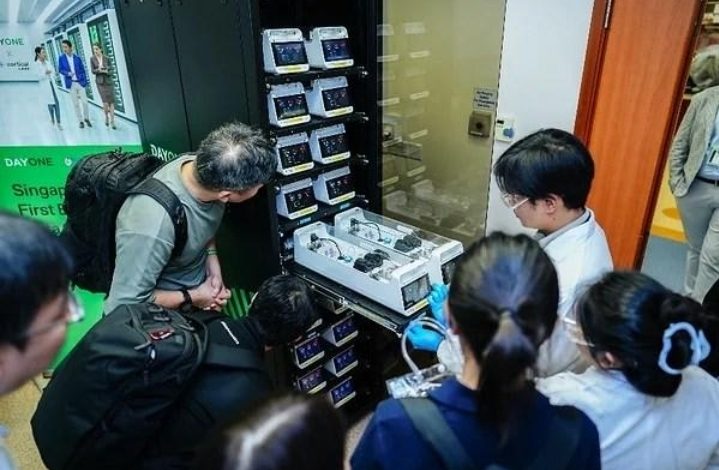
Singapore has unveiled what is being described as the world’s first biological data centre prototype, marking an unusual new direction for computing and artificial intelligence. The project brings together DayOne, Cortical Labs and the Yong Loo Lin School of Medicine at the National University of Singapore, combining living neurons with conventional computing infrastructure.
The prototype contains 20 biological computing units, with each unit using roughly 800,000 lab-grown human neurons. Together, the system contains approximately 16 million neurons connected to silicon-based hardware. Instead of relying entirely on conventional processors, the neurons can process information through biological electrical activity, giving researchers an opportunity to study a completely different approach to computation.
One of the biggest motivations behind the project is energy efficiency. Modern AI systems require enormous amounts of electricity, particularly when operating large data centres filled with GPUs. Biological computing could potentially perform certain types of processing using substantially less energy, although the Singapore system remains a prototype and is not currently positioned as a replacement for conventional AI data centres.
Researchers are also exploring applications beyond AI. Biological computing could eventually be investigated for drug discovery, neurological research, robotics, cybersecurity and other adaptive computing tasks. The ability of living neurons to learn and respond to changing information makes them particularly interesting for researchers looking for computing architectures that behave differently from traditional silicon processors.
The development also comes as Singapore expands its conventional data-centre infrastructure. On August 21, the government provisionally allocated 200 megawatts of new data-centre capacity to four operators, while emphasizing more sustainable infrastructure.
Singapore’s biological data centre therefore represents an early experiment rather than a finished commercial technology. If researchers can demonstrate that living neurons can reliably perform useful computational workloads while consuming far less energy, biological computing could eventually become an important complement to silicon-based AI infrastructure.