Nvidia Unveils GR00T 2 to Teach Robots Human Skills Through Video
The new AI model learns complex physical tasks from human demonstrations, helping robots perform delicate activities and transfer skills across different machines.

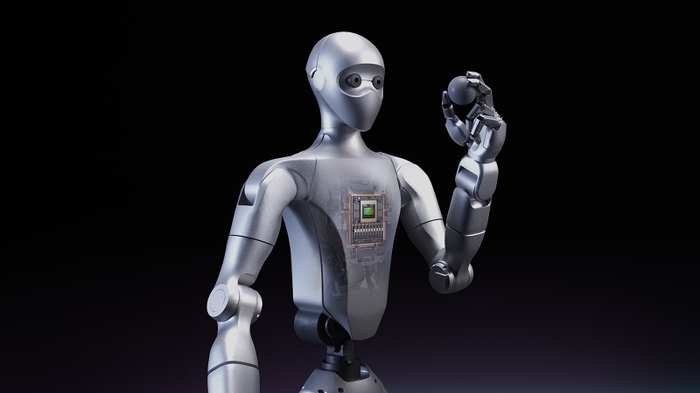
Nvidia has unveiled GR00T 2, a new artificial intelligence model designed to help humanoid robots learn and perform complex physical tasks by observing human activities. Announced on November 9, 2026, at the Conference on Robot Learning in Austin, Texas, the model is built on Nvidia’s Cosmos platform and trained using diverse robot and human data, including 100,000 hours of open-source first-person human video. The technology is designed to improve how robots understand their surroundings, predict the consequences of their actions and carry out tasks requiring precision and coordination.
According to Nvidia, GR00T 2 demonstrated impressive results during testing, completing at least 40 out of 50 evaluated tasks without receiving demonstrations specifically for those tasks. When provided with one demonstration per task, it achieved an average success rate of 71 per cent, increasing to 95 per cent after five demonstrations. Another important capability is skill transfer, allowing robots to learn movements from human demonstrations and apply those skills to different robot bodies without requiring additional demonstrations from each machine. This could significantly reduce the time and resources needed to train robots for new responsibilities.
Several companies are already exploring the technology for practical applications. Foxconn is applying GR00T 2 to factory automation, particularly server manufacturing, while Siemens is evaluating it for industrial operations. Robotics company Nexuni is testing the model for laundry handling, demonstrating its potential beyond traditional manufacturing environments. Nvidia has also introduced Isaac Lab 3.0, an upgraded open-source simulation framework that allows developers to train and evaluate robots in virtual environments. The company says its latest system achieved up to 2.5 times the training throughput of an earlier version in a vision-based robotic manipulation benchmark.
The announcement represents another major development in Nvidia’s ambition to advance physical AI, a field focused on bringing artificial intelligence into machines that interact with the physical world. By combining human video, robotic demonstrations, advanced simulation and AI agents, the company hopes to make robots more adaptable and capable of handling tasks that previously required extensive specialised training. Although GR00T 2 is still being tested across different industrial applications, its development could accelerate the adoption of intelligent robots in manufacturing, logistics, healthcare and everyday environments.