
Tesla Begins Optimus Humanoid Robot Production in California
Tesla has started early production of its Optimus humanoid robots at its Fremont factory, marking a major step towards commercial robotics as Elon Musk targets deliveries to external customers by the end of 2027.

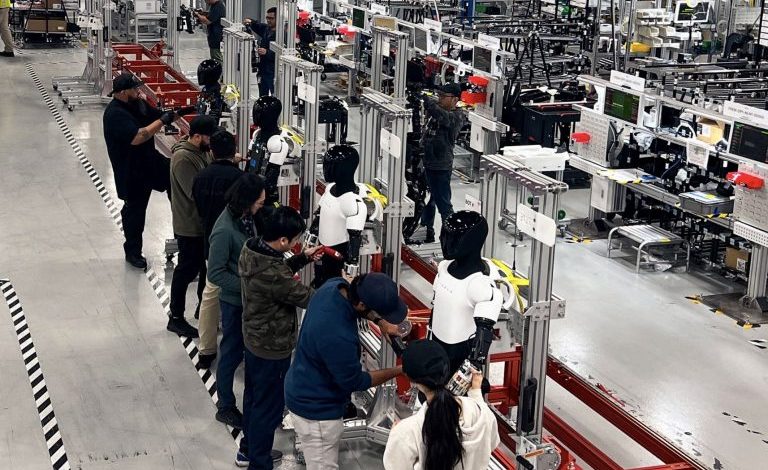
Tesla has officially begun producing its Optimus humanoid robots at its manufacturing facility in Fremont, California, marking a significant milestone in the company’s efforts to expand beyond electric vehicles into artificial intelligence and robotics. The announcement was made on October 21, 2026, as part of Tesla’s third-quarter shareholder update. The company described the robots coming off the production line as its first production-quality units, indicating that its manufacturing process has reached a stage it considers suitable for a commercial product. The factory space previously used to manufacture vehicles has been repurposed to support the new robotics programme. However, Tesla emphasised that production remains in its early stages and that further improvements to the robot’s design and manufacturing process will be necessary before large-scale commercial deployment.
Tesla CEO Elon Musk said the company expects to increase production gradually, with a target of reaching approximately 20,000 Optimus robots per week after at least a year of scaling up. He warned that the manufacturing process would initially be challenging because humanoid robots contain thousands of components and require complex coordination between mechanical systems, sensors, software and artificial intelligence. One of the most difficult engineering challenges involves producing robotic hands capable of performing delicate and varied tasks reliably. Musk also stressed that the robots must be safe, durable and dependable before they can be supplied to customers. His comments indicate that beginning production is only the first stage of a longer process involving engineering improvements, testing and manufacturing expansion.
The company plans to use Optimus in industrial environments before expanding its availability to other customers. Humanoid robots could eventually perform repetitive, physically demanding or potentially dangerous tasks in factories and warehouses, helping businesses improve productivity and reduce workers’ exposure to certain hazards. Tesla has also established an initiative known as Optimus Academy, where robots will practise different tasks and generate training data to improve the artificial intelligence systems controlling their movements. Unlike Tesla’s vehicles, which can generate substantial amounts of driving data, humanoid robots currently have a much smaller real-world deployment base. The training programme is intended to help address that limitation by providing more examples of how robots should respond to different situations and environments.
Another important development is Tesla’s plan to integrate its next-generation AI5 chip into Optimus, with Musk indicating that the upgrade could take place around April 2027 if development proceeds as planned. The chip is expected to provide substantially more computing power for processing sensor information, controlling movements and supporting complex tasks. Humanoid robots must coordinate many moving joints while interpreting their surroundings, making real-time computation particularly important. Nevertheless, more computing power alone will not guarantee that Optimus can perform complicated jobs independently. Tesla still needs to improve the robot’s software, physical dexterity and ability to operate consistently in environments that may differ significantly from controlled demonstrations. The company has indicated that further demonstrations will show its progress towards performing tasks that are not simply pre-programmed.
Tesla expects to begin delivering Optimus robots to external customers towards the end of 2027, although this timeline depends on successfully resolving the remaining engineering and manufacturing challenges. The company is also preparing additional production capacity in Texas, where a second manufacturing line is under construction. Its long-term plans reflect an ambition to make humanoid robots a major part of its business alongside electric vehicles, autonomous driving and AI infrastructure. However, the commercial opportunity remains uncertain because the robots must demonstrate consistent performance, acceptable operating costs and reliable safety standards before businesses can deploy them widely. Tesla’s production announcement is an important step, but the coming year will determine whether the company can turn its early manufacturing progress into a dependable commercial robotics operation.




