World Cup 2026: England vs DR Congo — From Zaire’s pain to DR Congo’s pride: How Kane’s brilliance finally broke Africa’s brave resistance
52 years after Zaire carried Africa’s hopes alone, DR Congo showed how far African football has travelled.

By Paul Lucky Okoku
The scoreboard recorded England’s victory. History recorded Africa’s progress.
Sometimes football asks us to remember before it allows us to appreciate.
As I watched England battle DR Congo in the FIFA World Cup 2026, my thoughts travelled back fifty-two years—not to England, but to Africa’s first lonely footsteps on football’s biggest stage.
Back then, they were called Zaire.
Africa had only one place at the FIFA World Cup.
For those of us who grew up watching African football, those memories have never disappeared.
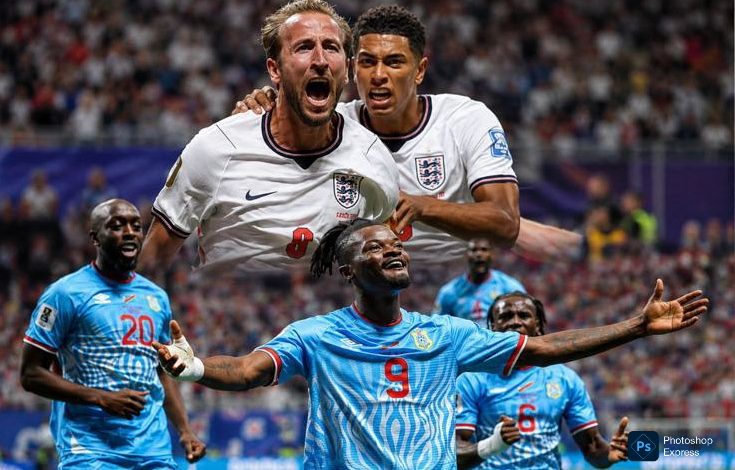
England eventually defeated DR Congo 2-1.
That is what the official record will forever show.
But anyone who watched this remarkable contest knows that the final score tells only part of the story.
The greater story belongs to African football.
Football is often judged by trophies.
I believe it should also be judged by progress.
Fifty-two years after Zaire endured one of the most painful tournaments in World Cup history, DR Congo stood toe-to-toe with one of football’s greatest powers, leading England for more than an hour before finally yielding to the brilliance of one extraordinary striker.
That is not merely a result.
That is evolution.
The England–DR Congo match was more than a knockout fixture.
It became a living reminder that African football has travelled an extraordinary distance—from participation to genuine competition.
History did not remember England’s victory alone. It also remembered how far African football has come.
Football never stands still. Each generation inherits the game from those who came before, then carries the responsibility of leaving it stronger for those who follow.
When Africa Carried Only One Dream
There was a time when simply qualifying for the FIFA World Cup was Africa’s greatest football achievement.
In 1974, the tournament was hosted by West Germany, and Africa was allocated just one place at the FIFA World Cup. To earn that lone ticket, Zaire—today’s Democratic Republic of the Congo, located in Central Africa—had to survive one of the continent’s most demanding qualification campaigns.

Zaire’s journey to West Germany unfolded in four stages. They first eliminated Togo, then survived a difficult second-round battle against Cameroon, which required a playoff. In the third round, they overcame Ghana, one of Africa’s leading football nations at the time, before advancing to the final qualification group alongside Morocco and Zambia, where Africa’s only World Cup place was decided.
Zaire’s Road to the 1974 FIFA World Cup
First Round – Togo
First Leg: Togo 0–1 Zaire
Second Leg: Zaire 3–0 Togo
Zaire advanced 4–0 on aggregate.
Second Round – Cameroon
First Leg: Zaire 2–0 Cameroon
Second Leg: Cameroon 1–0 Zaire
Playoff: Zaire 3–0 Cameroon
Zaire advanced after the aggregate finished 2–2.
Third Round – Ghana
First Leg: Ghana 1–0 Zaire
Second Leg: Zaire 4–1 Ghana
Zaire advanced 4–2 on aggregate.
Final Qualification Group
vs. Morocco
Zaire 3–0 Morocco
Morocco 0–2 Zaire (match awarded by FIFA after Morocco withdrew from the return fixture).
vs. Zambia
Zambia 0–2 Zaire
Zaire 2–1 Zambia
By overcoming Togo, Cameroon, Ghana, Morocco, and Zambia, Zaire became the first nation from sub-Saharan Africa to qualify for a FIFA World Cup. It was far more than a football achievement. It carried the hopes, pride, and aspirations of an entire continent that, at the time, had only one opportunity to compete on football’s biggest stage.
The Pain That Changed the Conversation
Zaire’s reward was one of the tournament’s most daunting groups, alongside Scotland, Yugoslavia, and the defending world champions, Brazil.
The World Cup campaign ended painfully:
Scotland 2–0 Zaire
Yugoslavia 9–0 Zaire
Brazil 3–0 Zaire
Three matches.
Three defeats.
No goals scored.
Fourteen goals conceded.
For decades, those scorelines became an unfair symbol of African football. Many forgot the extraordinary journey that had brought Zaire to West Germany. Instead, the 9–0 defeat overshadowed one of the greatest qualification campaigns by an African nation and reinforced negative stereotypes about African football.
History, however, did not end in 1974.
In 1978, Tunisia became the first African nation to win a FIFA World Cup match, defeating Mexico 3–1.
In 1982, Algeria stunned the football world by defeating defending European champions West Germany 2–1 before becoming victims of the infamous “Disgrace of Gijón.”
In 1986, Morocco became the first African nation to reach the Round of 16.
In 1990, Cameroon reached the quarter-finals and transformed global perceptions of African football.
As African nations continued to prove themselves on football’s biggest stage, FIFA gradually expanded the continent’s representation—from one place in 1974 and 1978, to two places beginning in 1982, and eventually to the significantly larger allocation Africa enjoys today.
That is why DR Congo’s courageous performance against England was about much more than ninety minutes of football.
It was another chapter in a remarkable journey that began with pioneers who dared to dream when Africa carried only one World Cup ticket.
When One Match Stopped a Nation
To understand what Zaire’s qualification meant to Africa, one must also understand Nigeria’s heartbreak.
In 1973, Africa had just one place at the FIFA World Cup. Every qualifying match carried the hopes of an entire nation—and, in many ways, the expectations of a continent still fighting for respect on football’s biggest stage.
For Nigeria, that dream came crashing down against its fiercest West African rival, Ghana.
The first leg, played at the National Stadium in Lagos on 10 February 1973, remains one of the most dramatic and emotional matches in African football history.
1974 FIFA World Cup Qualifier
First Leg – Lagos, Nigeria
Nigeria 2–3 Ghana
Nigeria’s goals: Yakubu Mambo (2)
Ghana’s goals: Kwasi Owusu (3)
Second Leg – Accra, Ghana
Ghana 0–0 Nigeria
Aggregate: Ghana advanced 3–2.
For those who witnessed that era, one name still echoes through Nigerian football history—Kwasi Owusu.
His hat-trick in Lagos silenced a nation and shattered Nigeria’s dream of reaching the 1974 FIFA World Cup. To many Nigerian supporters of that generation, he became one of the most feared opponents they had ever seen.
The heartbreak was too much for many fans to bear.
When Ghana scored the decisive third goal, emotions boiled over. The match descended into chaos and was abandoned before full time as spectators invaded the pitch. Outside the stadium, violence erupted, and a bus carrying Ghanaian supporters was set ablaze.
Recognizing the seriousness of the situation, the Military Governor of Lagos State, Brigadier Mobolaji Johnson, came down from the VIP section and personally coordinated security efforts to escort the Ghanaian players safely from the field and back to their hotel. The Federal Military Government, under General Yakubu Gowon, later ensured that the Ghanaian delegation returned home safely.
That painful night became one of the defining moments in Nigerian football history.
While Ghana advanced, another African nation—Zaire—continued its remarkable journey, eventually overcoming Togo, Cameroon, Ghana, Morocco, and Zambia to become Africa’s lone representative at the 1974 FIFA World Cup.
History remembers Zaire for the painful defeats they suffered in West Germany.
Those of us who lived through that era remember something much deeper.
We remember when one World Cup ticket carried the hopes of an entire continent.
That is why every African nation that qualifies today stands on the shoulders of those pioneers—and why DR Congo’s courageous performance against England in 2026 represents another milestone in Africa’s extraordinary football journey.
The Match That Refused to Follow the Script
Many expected England to progress comfortably.
DR Congo had other ideas.
Inside seven minutes, Brian Cipenga stunned England with the opening goal, silencing expectations and reminding everyone that knockout football respects neither rankings nor reputations.
For long stretches, DR Congo defended with courage, organization and remarkable discipline.
Goalkeeper Lionel Mpasi frustrated England with a series of outstanding saves.
England enjoyed possession.
England created opportunities.
But DR Congo refused to surrender.
This was not an underdog hanging on.
This was a confident African team competing as equals.
Harry Kane: When Intelligence Becomes Technique
Then came the moment that separates good strikers from truly great ones.
Watch Harry Kane carefully.
Before he advances the ball, he lifts his eyes.
Not for admiration.
For information.
In one glance he studies the goalkeeper.
He measures the defender.
He calculates space.
Only then does he push the ball into the perfect shooting lane.
The defender is now half a step behind.
The goalkeeper has shifted.
The decision has already been made.
The strike simply completes the calculation.
With tremendous power and exquisite precision, Kane bent his effort beyond the goalkeeper into the top corner.
The stadium celebrated the finish.
Football students admired the thinking.
That goal belonged not only to Kane’s right foot.
It belonged to his football intelligence.
His equalizing header and spectacular winner both came from the impact of substitute Anthony Gordon, whose introduction transformed England’s attack and changed the rhythm of the match.
There are goalscorers.
There are elite goalscorers.
Then there are strikers whose minds operate just a fraction quicker than everyone else.
Harry Kane belongs in that final category.
Evidence Beyond the Statistics
Statistics explain matches.
They do not always explain performances.
England completed the comeback through relentless pressure.
DR Congo answered with tactical discipline, defensive organization and fearless commitment.
Many Congolese players now compete professionally across Europe’s leading leagues, including England.
There was no intimidation.
Only belief.
England won because they eventually found the moments that championship teams discover.
DR Congo lost without diminishing their reputation.
Sometimes defeat enhances respect.
This was one of those occasions.
Beyond the Scoreline
Some will simply read:
England 2, DR Congo 1.
I saw something much bigger.
I saw an African nation refusing to play with fear.
I saw tactical maturity.
I saw physical preparation.
I saw belief.
Most importantly, I saw proof that the gap separating Africa from traditional football powers continues to narrow.
A Footballer’s Reflection
Having represented Nigeria internationally, I understand that World Cup matches are decided by moments.
Not minutes.
Moments.
One intelligent movement.
One correct decision.
One perfect finish.
Harry Kane produced those moments.
Yet DR Congo produced something equally valuable.
Hope.
Not the hope of participation.
The hope of genuine competition.
That is the greatest victory African football can claim from this evening.
Lessons for Africa—and a Wake-Up Call for Nigeria
If this World Cup has taught us anything, it is that talent alone is no longer enough.
Africa has never lacked gifted footballers.
What separates champions from contenders is the quality of the system behind the players.
DR Congo, Morocco, Senegal, Ghana, and several other African nations have demonstrated courage, tactical discipline, athleticism, and belief. They have shown that the gap between Africa and the traditional football powers continues to narrow.
The next challenge is transforming brave performances into consistent victories.
That requires more than talented players.
It requires visionary leadership.
It requires long-term planning.
It requires accountability.
It requires continuity.
African football must continue investing in:
Youth development.
Coach education.
Tactical intelligence.
Sports science and performance analysis.
Modern training facilities.
Sports medicine and injury prevention.
Professional infrastructure.
Mental preparation and game management.
Data analytics and emerging technologies, including Artificial Intelligence, to support coaching, scouting, player development, and performance analysis.
For Nigeria, however, the lessons are even more urgent.
A country blessed with one of the world’s richest pools of football talent should never become comfortable watching the FIFA World Cup from home.
Nigeria’s greatest challenge is no longer producing players.
It is producing a football system worthy of those players.
We need visionary leaders who understand that success cannot be built on short-term decisions and emotional reactions.
We need administrators who plan beyond the next tournament.
We need competent coaches who are empowered to build, not merely survive.
We need modern facilities that prepare players to compete with the world’s best.
We need transparent selection processes based on merit.
We need stronger grassroots and school football, where tomorrow’s Super Eagles and Super Falcons begin their journeys.
Above all, we need a culture of accountability.
In football, as in leadership, responsibility matters.
When results consistently fall below expectations, leaders must honestly evaluate their performance. Sometimes the best decision is to continue with a clear long-term vision. At other times, a change in leadership can provide the fresh direction and renewed confidence that a team or organization needs.
Accountability should never be viewed as punishment.
It should be viewed as leadership.
African football has made remarkable progress.
Now it must become consistently excellent.
And for Nigeria, missing the FIFA World Cup should not simply be a disappointment.
It should be a turning point.
The time has come to stop relying on talent alone and start building a football system capable of producing champions—for this generation and for generations yet to come.
Africa’s Next Competitive Advantage: Artificial Intelligence
If Africa truly wants to compete consistently with the world’s football powers, embracing Artificial Intelligence (AI) is no longer optional—it is becoming essential.
The world’s leading clubs and national teams already use AI to support decision-making in ways that were unimaginable just a decade ago.
AI can help coaches:
Analyze opponents’ strengths and weaknesses.
Monitor player fatigue and reduce injury risks.
Measure physical workloads during training and matches.
Evaluate tactical formations and identify weaknesses.
Recommend substitutions based on player performance and physical output.
Assist in talent identification and youth scouting.
Improve set-piece organization.
Enhance goalkeeper preparation through penalty and shooting-pattern analysis.
The important point is this:
AI should never replace the coach.
It should empower the coach.
The final decision will always belong to human beings.
But those decisions should be informed by better information.
Football has entered the era of data-driven performance.
Africa cannot afford to be left behind.
Countries that embrace technology, sports science, performance analytics, and Artificial Intelligence will gain advantages that are often invisible to supporters—but decisive on the pitch.
Talent may win a match.
Preparation wins tournaments.
And in modern football, Artificial Intelligence has become one of the most powerful tools of preparation.
Looking Ahead
The objective for African football can no longer be reaching the World Cup.
That chapter has already been written.
The next chapter is reaching semifinals.
Winning championships.
Lifting the FIFA World Cup itself.
Progress demands that we keep raising our standards.
The Road Forward
Every generation benefits from sacrifices made by those who came before.
The pioneers of Zaire carried Africa’s first dream.
Today’s DR Congo carried Africa’s growing confidence.
Tomorrow’s generation must carry Africa’s greatest ambition.
*Conclusion: History Never Travels Backward*
England deserved their victory.
Harry Kane reminded the football world why he remains one of its finest strikers.
But long after this scoreline fades from memory, another truth will remain.
Fifty-two years ago, Africa arrived hoping to belong.
Today, Africa arrives expecting to compete.
That is the true story of England versus DR Congo.
History never travels backward.
It only asks each generation to move the game a little further than the last.
Football was not merely played tonight. History quietly took another step forward.
Paul Lucky Okoku, FIFA Legend, CAF Silver Medalist, Former Nigerian Super Eagles & Flying Eagles International, Former Olympic Qualifying Team Member, Football Analyst and Founder, GTCF writes from Atlanta USA