
China Races to Build Nuclear Fusion Power for the AI Era
Surging electricity demand from artificial intelligence data centres is accelerating China’s investment in nuclear energy, including ambitious efforts to develop commercial fusion power.

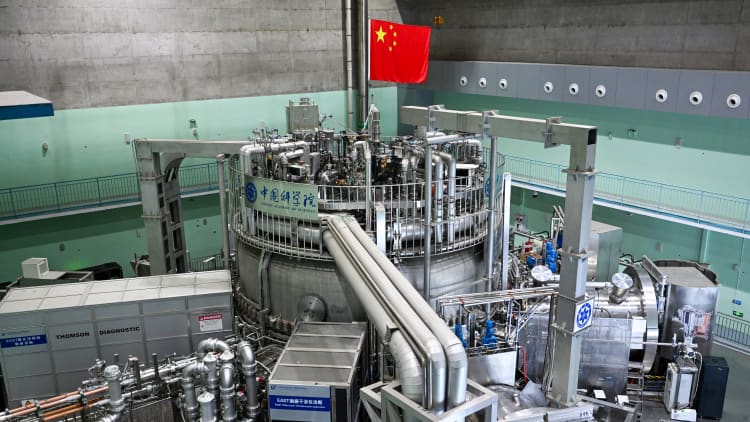
China is rapidly expanding its nuclear-energy ambitions as the country’s growing artificial-intelligence industry creates a huge demand for electricity. A recent Financial Times report says AI data centres are expected to quadruple their electricity consumption in China to about 774 terawatt-hours by 2030. This growing demand is encouraging Beijing and Chinese companies to explore both conventional nuclear reactors and emerging technologies such as nuclear fusion.
China is already building more conventional nuclear reactors than any other country, with more than half of the 58 nuclear power plants currently under construction worldwide located in China. At the same time, the country is developing smaller modular reactors that could potentially be installed at existing industrial and power-generation sites. The strategy is intended not only to supply electricity for AI and manufacturing but also to strengthen China’s energy security and domestic technology supply chains.
The more ambitious part of the programme is nuclear fusion, the same basic process that powers the Sun. Unlike conventional nuclear fission, which splits heavy atoms, fusion combines light atomic nuclei and has the potential to produce large amounts of energy with very low carbon emissions. China has invested heavily in fusion research, while its BEST project is targeting a demonstration of net fusion power gain and electricity generation around 2030.
Private companies are also becoming increasingly involved. Shanghai-based NovaFusionX is developing a magnetic-plasma approach known as field-reversed configuration and aims to achieve its first plasma by the end of 2026, with a target of demonstrating net energy gain by 2029. Separately, China’s ENN Group has begun construction of the Helong-2 hydrogen-boron fusion experimental platform in Hebei, with equipment installation planned for 2027 and experiments expected to begin later that year.
Despite the rapid investment, commercial fusion power remains technically difficult and has not yet become a commercially established source of electricity. China says it aims for commercial utilisation of fusion energy by 2050, while researchers still face major challenges involving plasma stability, materials, engineering and achieving sustained net energy production. The current push nevertheless shows how the AI boom is becoming closely connected with the global race to develop new sources of reliable, large-scale electricity.




