
Sam Altman Meets Samsung Executives to Strengthen OpenAI’s AI Chip Partnership
OpenAI CEO Sam Altman has met with approximately 50 senior Samsung executives in South Korea to discuss artificial intelligence, semiconductor supplies and opportunities for deeper cooperation as global demand for AI chips continues to rise.

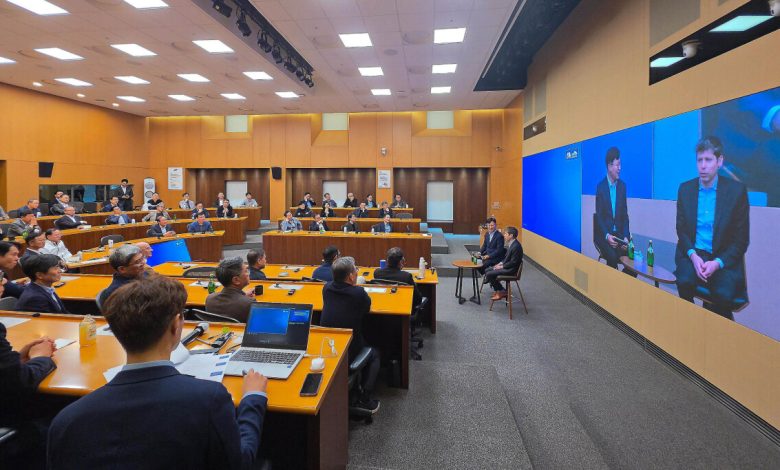
OpenAI CEO Sam Altman met with around 50 senior executives from Samsung Group on October 31, 2026, during a visit to South Korea aimed at strengthening cooperation between the two companies. The meeting took place at Samsung’s Human Resources Development Centre in Yongin, Gyeonggi Province, bringing together leaders from the company’s electronics, financial services and biotechnology businesses. Discussions focused on how artificial intelligence could transform industries, influence corporate decision-making and create new business opportunities over the next decade. Samsung described the gathering as part of its efforts to help senior executives understand the direction of AI development and prepare their businesses for an increasingly AI-driven economy.
The meeting comes as OpenAI seeks to secure reliable supplies of advanced memory chips needed to operate its growing AI infrastructure. Modern AI data centres require enormous quantities of high-performance memory to process information and support increasingly sophisticated models. Samsung is one of the world’s leading semiconductor manufacturers, particularly in dynamic random-access memory (DRAM) and high-bandwidth memory (HBM), making it an important potential supplier for OpenAI’s expansion plans. Global competition for these components has intensified as technology companies invest heavily in AI computing facilities. Industry shortages and rising memory prices have made long-term supply relationships increasingly important for companies seeking to expand their computing capacity.
The discussions build on an existing partnership announced in October 2025, when Samsung and SK Group joined OpenAI’s Stargate initiative. The collaboration covers the supply of advanced memory chips and the development of global AI infrastructure. Samsung SDS agreed to cooperate on AI data centres and enterprise AI services, while Samsung C&T and Samsung Heavy Industries planned to explore floating offshore data centres. These facilities could provide additional computing capacity while addressing some of the challenges associated with land availability, power supply and cooling. OpenAI’s Stargate programme is intended to support the large-scale infrastructure required to train and operate advanced AI systems. However, the latest meeting did not result in a publicly announced new chip supply agreement.
Samsung is also accelerating its internal adoption of artificial intelligence. The company has been training executives to use generative AI for organising business information, analysing corporate materials and supporting management decisions. According to Samsung, approximately 2,300 executives are undergoing AI training, with the company targeting completion of employee training by February 2027. Dedicated AI teams are also being established across its business divisions to develop strategies suited to different operations, including manufacturing, research and development, marketing and financial services. Altman’s meeting therefore provided an opportunity for Samsung’s leadership to examine how AI could influence not only the products it manufactures but also the way the conglomerate manages its global operations.
The visit highlights South Korea’s growing importance in the global AI supply chain. Samsung and SK Hynix are among the major suppliers of advanced memory products used in AI servers, while international companies increasingly compete to secure sufficient semiconductor capacity. Altman also held discussions with SK Group Chairman Chey Tae-won, with representatives from SK Hynix and SK Telecom reportedly involved. The broader objective is to strengthen cooperation around memory chips, telecommunications and data-centre development. As AI models become more powerful and demand for computing increases, partnerships between AI developers and semiconductor manufacturers are likely to become increasingly strategic. Although the latest meetings have not confirmed additional supply contracts, they demonstrate OpenAI’s continued efforts to strengthen its relationships with South Korea’s leading technology companies.




