
Hubble Data Hint at a Planet Born From the Remains of a Dying Star
Astronomers have uncovered unusual chemical signatures in decades-old Hubble Space Telescope observations, suggesting that a Jupiter-sized planet may have formed from material expelled by a dying star rather than from the cloud of gas and dust that typically gives birth to planetary systems.

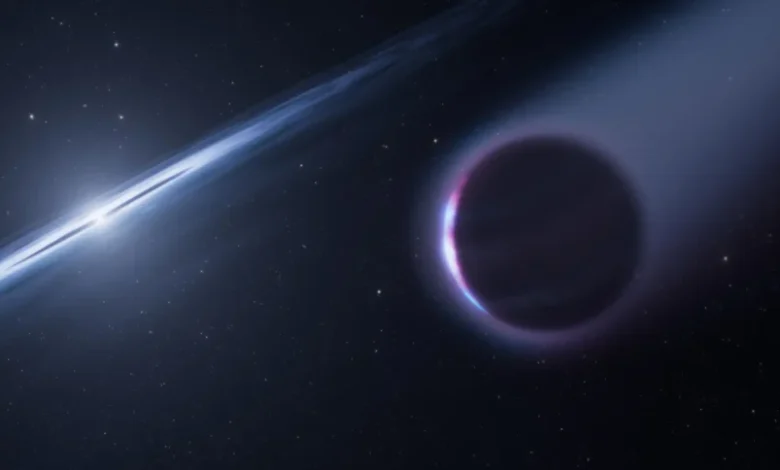
Astronomers have discovered evidence pointing to a possible second-generation planet in a distant star system, offering a new perspective on how worlds can form in the aftermath of stellar death. The discovery centres on HS 0209+0832, a white dwarf system whose unusual chemical signatures were recorded by the Hubble Space Telescope in 1999. Researchers revisited the archived observations and identified evidence that the system may contain a planet formed from material released when its original star reached the end of its life. The research was announced by NASA and the European Space Agency on October 5, 2026. If confirmed, the finding would provide an important example of how planetary formation may continue even after a star has exhausted its nuclear fuel and shed its outer layers.
The breakthrough came when astronomer Jamie Williams and colleagues re-examined chemical features in the old Hubble data that had remained unidentified for more than 25 years. The original observations contained approximately 100 unexplained spectral features. Using an updated database of chemical signatures, Williams identified patterns associated with niobium, a heavy element found on Earth and used in applications including specialised alloys and medical technology. The unusually high abundance of niobium, alongside other chemical clues, suggested that the surrounding material had a different origin from the gas and dust normally associated with newly formed stars. Researchers interpreted these chemical patterns as potential evidence that a planet in the system formed from material enriched during the death of its parent star.
The suspected planet belongs to a category scientists call a second-generation planet. Most planets, including Earth, are believed to form from discs of gas and dust surrounding young stars. In contrast, a second-generation planet could develop from material expelled into space when an older star expands and loses its outer layers during its final stages of evolution. The remaining stellar core becomes a white dwarf, a compact object that gradually cools over time. Material released during the star’s transformation can potentially gather into a new disc, creating conditions in which planets may form. Such a process would mean that planetary systems do not necessarily disappear completely when their original stars die. Instead, some of the material from a dying star could become the raw ingredients for an entirely new generation of worlds.
Niobium is particularly important to the investigation because its presence can provide clues about the conditions under which planetary material formed. Unlike many common elements, niobium and other heavy elements are not primarily produced through ordinary hydrogen fusion in the cores of stars. Their abundance can therefore help astronomers reconstruct the history of material surrounding a stellar remnant. In this case, the chemical composition detected in the HS 0209+0832 system appears consistent with material influenced by the final stages of stellar evolution. However, researchers have not yet directly imaged the proposed planet or conclusively demonstrated that it exists. The evidence currently supports a promising candidate, and additional observations will be needed to establish whether a second-generation planet is responsible for the unusual chemical signatures.
The discovery could reshape future research into planetary formation around white dwarfs and the long-term evolution of planetary systems. Scientists already know that some planets can survive their host stars’ transformations, although those planets may experience extreme environmental changes as their stars expand and lose mass. The possibility that entirely new planets can form afterwards introduces another stage into the story of planetary evolution. Researchers hope that future observations, including studies using the James Webb Space Telescope, will help test the interpretation and reveal more about the composition and structure of the suspected world. For now, the Hubble discovery demonstrates the scientific value of archival data: observations collected decades ago can still produce major discoveries when new analytical techniques and improved chemical databases become available.




