James Webb Telescope Detects Changing Water Clouds on a Distant World
NASA’s James Webb Space Telescope has directly observed water clouds changing thickness on a cold, Jupiter-sized brown dwarf 7.5 light-years from Earth, giving scientists an unprecedented view of weather and atmospheric chemistry beyond our Solar System.

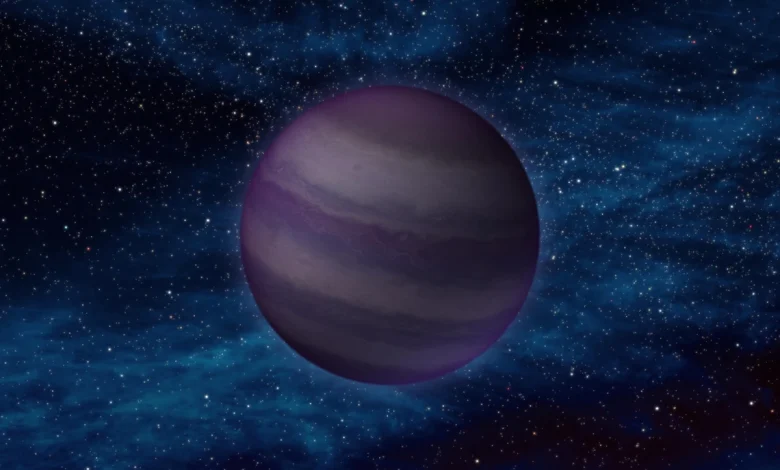
Astronomers using the James Webb Space Telescope have discovered changing water clouds and complex atmospheric activity on WISE 0855, one of the coldest known brown dwarfs. The findings, announced on October 8, 2026, mark the first direct confirmation that water clouds outside our Solar System change thickness over time. Led by Brittany Miles of the University of Arizona’s Steward Observatory, the research team observed the distant object for 11 hours, collecting measurements of its light every 15 minutes. The observations provided an unusually detailed picture of how its atmosphere changes as it rotates, helping scientists separate the effects of clouds, temperature variations and atmospheric gases. The research was published in The Astrophysical Journal.
WISE 0855 is located approximately 7.5 light-years from Earth and is roughly the size of Jupiter. However, it is not technically a planet or a fully developed star. It belongs to a class of objects known as brown dwarfs, which are too small to sustain the hydrogen fusion that powers ordinary stars. With an estimated temperature of about 265 kelvin, or approximately minus 8 degrees Celsius, WISE 0855 is exceptionally cold compared with most brown dwarfs. Its relatively low temperature makes it particularly valuable to astronomers because water can condense into clouds in its atmosphere. Studying this object provides an opportunity to investigate atmospheric processes that may also occur on giant planets, including Jupiter, under different temperature and pressure conditions.
One of the most important findings is that the water clouds become thicker and thinner as different regions of the brown dwarf rotate into view. Previously, astronomers could detect changes in an object’s brightness, but it was difficult to determine whether those changes came from cloud cover, temperature differences or atmospheric chemistry. Webb’s sensitive infrared instruments allowed researchers to distinguish these factors more effectively. By examining the spectrum of light at frequent intervals, the team could track changes associated with different atmospheric features. This represents a significant improvement in the study of distant worlds because scientists can begin observing atmospheric weather patterns directly through their effects on light, rather than relying entirely on indirect estimates or computer simulations.
The telescope also detected changing signals associated with carbon monoxide and phosphine, gases that provide information about activity deeper within the brown dwarf’s atmosphere. Researchers linked these variations to convection, a process in which heat causes material from deeper, hotter regions to rise towards cooler upper layers. Similar atmospheric mixing occurs on Jupiter, where rising gases transport chemicals from deep within the planet. By observing these chemical changes alongside the movement of water clouds, astronomers gained evidence that multiple atmospheric processes are operating simultaneously on WISE 0855. The findings suggest that the brown dwarf’s atmosphere is not static but continuously changing, with cloud formation, temperature differences and chemical transport all contributing to its observed behaviour.
The discovery could improve scientists’ understanding of brown dwarfs and giant exoplanets, particularly as astronomers work towards studying smaller, potentially Earth-like worlds. Water clouds, atmospheric circulation and chemical composition can influence how a planet absorbs and emits radiation, making them important factors in understanding its climate. The techniques demonstrated in this research may help scientists interpret observations of other distant objects and improve models of their atmospheres. However, WISE 0855 is not an Earth-like habitable planet, and the presence of water clouds does not provide evidence of life. Instead, the achievement lies in the ability to observe atmospheric changes on a cold object beyond our Solar System. As Webb continues its observations, researchers hope to build a more detailed understanding of how weather and chemistry operate on worlds that cannot be studied directly by spacecraft.