NVIDIA Unveils Tool That Turns Idle PCs Into a Personal AI Data Centre
New Personal AI Router Connects Multiple Computers to Share Processing Power for Local AI Tasks

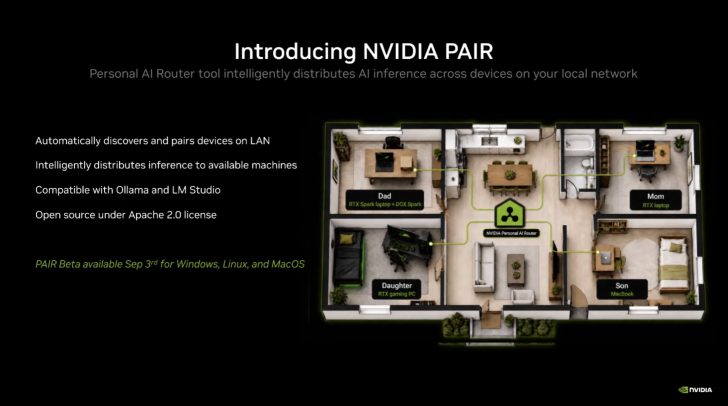
NVIDIA has introduced Personal AI Router (PAIR), an open-source software tool designed to connect multiple computers and graphics processors so they can work together on local artificial intelligence tasks. The company unveiled the technology at IFA 2026 as part of a broader push to make powerful AI computing available outside traditional cloud data centres.
PAIR allows compatible computers on the same network to contribute available processing capacity to AI workloads. Instead of requiring one machine to handle an entire task, the system can distribute workloads across several connected devices, potentially making better use of hardware that would otherwise remain idle. NVIDIA says the system can dynamically adjust as computers join or leave the network.
The technology is designed to work with a range of hardware, including NVIDIA GeForce RTX 20-series GPUs and newer models, RTX Professional GPUs, DGX Spark systems and Apple computers powered by M4 chips or later. PAIR can also work with local AI platforms such as LM Studio and Ollama, giving users more flexibility in how they run AI models on their own hardware.
Privacy is another important part of NVIDIA’s pitch for the system. Because AI processing can take place across devices on a local network rather than automatically sending workloads to a cloud provider, users can retain greater control over their computing environment. NVIDIA says PAIR uses a six-digit pairing process and mutual TLS encryption to secure communication between connected machines.
The launch reflects NVIDIA’s broader strategy of bringing AI capabilities closer to individual users. Alongside PAIR, the company is making it easier to install local AI agents on Windows systems and is preparing new RTX Spark computers designed specifically for AI workloads. Together, these developments point toward a future in which powerful AI applications can increasingly run locally, using a combination of personal computers rather than relying exclusively on large cloud data centres.