Webb Telescope Captures Icy Object Beginning to Transform Into a Comet
James Webb and Gemini North Observations Reveal Carbon Dioxide and Icy Dust Around Distant Centaur 450P/LONEOS

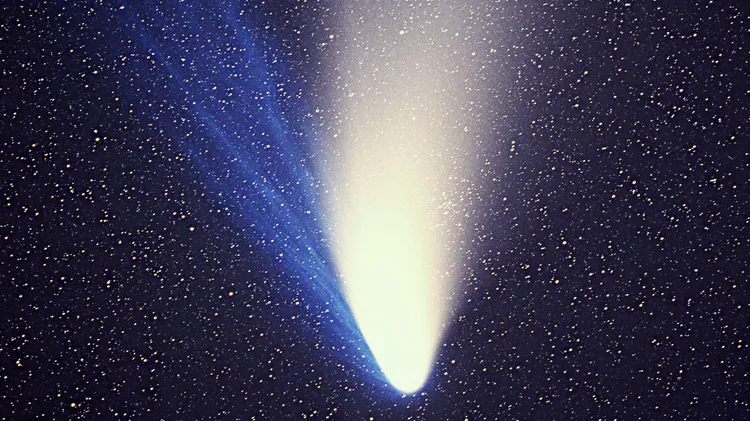
Astronomers using the James Webb Space Telescope and the Gemini North telescope have captured evidence of an icy object in the outer Solar System beginning to develop comet-like characteristics. The object, known as 450P/LONEOS, is a centaur that travels between the orbits of Jupiter and Neptune, roughly 4.8 billion kilometres from Earth.
Centaurs are icy bodies that occupy the region between the giant planets and are considered transitional objects because some eventually move closer to the Sun and become active comets. What makes 450P/LONEOS particularly interesting is that scientists have observed it developing a surrounding cloud of material, known as a coma, while it is still extremely far from the Sun.
Webb’s observations detected carbon dioxide around the object, along with icy dust and possible traces of crystalline water ice. Researchers did not detect water vapour or carbon monoxide, strengthening the evidence that carbon dioxide may be responsible for driving the activity observed around the distant body.
The discovery provides scientists with an unusual opportunity to study the earliest stages of comet formation. As an icy body moves through the Solar System and approaches the Sun, increasing temperatures can cause volatile materials to become active, releasing gas and dust. Observing this process at such an early stage could help researchers understand how primitive objects evolve and how comets acquire the features seen closer to the Sun.
The findings also demonstrate the growing ability of the James Webb Space Telescope to investigate objects within our own Solar System, rather than only distant galaxies and stars. By studying 450P/LONEOS alongside other icy bodies, astronomers hope to better understand the composition and evolution of material left over from the Solar System’s formation billions of years ago.