Sam Altman’s World Expands Zoom Deepfake Protection and AI Agent Verification
Sam Altman’s identity-verification company, World, has launched new tools for banks and financial institutions, combining human verification for Zoom meetings with identity credentials designed to help distinguish legitimate AI agents from malicious impersonators.

World, the digital identity company co-founded by OpenAI CEO Sam Altman, has expanded its verification technology to address growing concerns about deepfakes, online impersonation and AI-powered fraud. On October 18, 2026, the company announced a new identity-verification package designed specifically for banks and financial services businesses. The package combines its World ID application, World ID for Zoom and World ID for Agents, giving organisations tools to verify people participating in online meetings and establish credentials for AI agents acting on their behalf. The launch reflects a growing concern among businesses that advances in artificial intelligence are making it increasingly difficult to determine whether a digital interaction involves a genuine person or a convincing synthetic imitation.
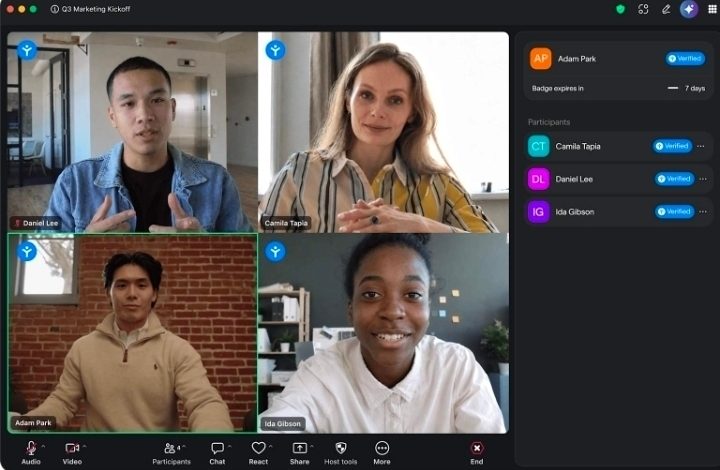
One of the central products, World ID for Zoom, is designed to help meeting participants establish that they are real people rather than AI-generated deepfakes. Once verified, a participant can display a human-verification badge during a Zoom meeting. The technology is intended for situations in which identity is particularly important, including financial discussions, business negotiations, board meetings and authorisation of sensitive transactions. World said the feature became generally available through the Zoom Marketplace following a limited beta that began in April 2026. The company argues that conventional video calls are no longer sufficient proof of identity because increasingly realistic AI-generated faces and voices can imitate genuine individuals. The verification badge provides an additional layer of assurance, although users should still confirm identities and transaction details through independent channels when handling high-value or sensitive requests.
World’s verification system builds on its existing World ID technology, which uses biometric verification to establish that an individual is a unique human. The company’s verification process involves an iris scan using its Orb device, alongside additional identity-confirmation steps. The resulting digital credential is intended to allow users to demonstrate that they have passed verification without repeatedly exposing all their personal information to every service they use. World promotes this approach as a way to establish trust in online interactions while limiting the amount of identifying information shared. However, the use of biometric data also raises privacy questions, particularly concerning consent, data protection, accessibility and public confidence in the organisations operating identity-verification systems. The wider adoption of such technology will depend on whether users and institutions consider its benefits sufficient to justify the associated privacy and security considerations.
The new financial-services package also includes World ID for Agents, a system designed to provide identity credentials for AI agents carrying out tasks on behalf of people. As businesses increasingly use AI systems to research information, interact with software and initiate workflows, organisations need ways to distinguish authorised agents from malicious bots or systems attempting to impersonate legitimate users. World says its technology allows people to delegate certain verified credentials to an AI agent, enabling that agent to present evidence of its authorisation to participating platforms. This could eventually help financial institutions establish whether an automated system is acting under a genuine human’s authority. Nevertheless, verifying an agent’s credentials does not automatically guarantee that its actions are safe, accurate or financially appropriate. Institutions will still need access controls, transaction limits, monitoring and human approval for sensitive operations.
The announcement comes amid rising concern about the financial consequences of deepfake fraud. Criminals can use synthetic audio and video to impersonate executives, colleagues, customers or business partners, potentially persuading employees to disclose confidential information or transfer money. A widely reported incident in 2024 involved an employee at a multinational company who was deceived into transferring approximately $25 million after participating in a video conference populated by deepfake representations of colleagues. Such incidents have strengthened calls for organisations to introduce additional identity checks rather than relying solely on familiar faces, voices or email addresses. World named Bain Capital, VanEck Funds, OpenExchange and Outtake among the initial design partners associated with its new offering, although the company did not identify a bank that had already adopted the complete package.
World’s expansion illustrates how the development of more capable AI systems is creating demand for technologies that establish trust in digital interactions. While AI agents may help businesses automate routine work and improve productivity, their growing ability to communicate and act independently also creates new opportunities for impersonation and fraud. World hopes that human-verification credentials and agent-authorisation tools can help financial institutions respond to these risks. However, no single identity system can eliminate deepfake attacks, and verification tools must be combined with strong cybersecurity practices, independent confirmation procedures and appropriate oversight. As banks and other businesses evaluate the technology, the key question will be whether it provides reliable protection without creating unnecessary privacy risks or barriers for legitimate users.