Scientists Detect Antineutrinos Produced Inside a Particle Collider for the First Time
Landmark CERN discovery opens a new chapter in particle physics by observing elusive antimatter particles generated during high-energy collisions.

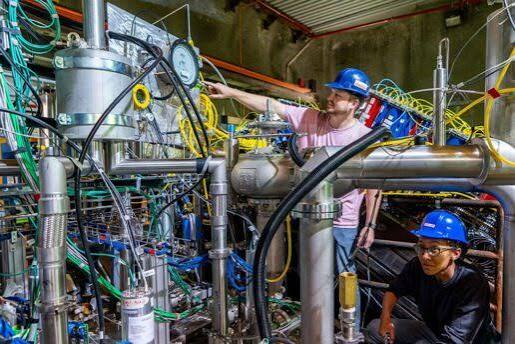
Scientists working at CERN’s Large Hadron Collider (LHC) have achieved a historic breakthrough by detecting electron antineutrinos produced directly inside a particle collider for the first time. While neutrinos generated by collider experiments had previously been observed, this marks the first confirmed detection of their antimatter counterparts originating from proton-proton collisions. The achievement provides physicists with a powerful new way to study some of the universe’s most mysterious particles and further validates key predictions of the Standard Model of particle physics.
The discovery was made using the FASERν detector, a specialized instrument positioned hundreds of meters from the collision point at the Large Hadron Collider. Although antineutrinos are produced in enormous numbers during high-energy collisions, they interact so weakly with matter that billions pass through every person each second without leaving a trace. Detecting them requires highly sensitive instruments capable of identifying the extremely rare occasions when one collides with ordinary matter. The successful observation demonstrates that scientists can now study these elusive particles under controlled laboratory conditions at unprecedented energies.
Antineutrinos are the antimatter counterparts of neutrinos and play a crucial role in understanding the fundamental laws of nature. By comparing how neutrinos and antineutrinos behave, physicists hope to uncover why the universe is dominated by matter even though the Big Bang should have produced equal amounts of matter and antimatter. The new measurements will also improve scientists’ understanding of particle interactions at extremely high energies, helping refine theoretical models used in both particle physics and astrophysics.
The achievement also demonstrates the growing scientific capabilities of the Large Hadron Collider beyond its traditional role of discovering new particles such as the Higgs boson. Experiments like FASER and SND@LHC have transformed the collider into a unique source of the highest-energy neutrinos and antineutrinos ever produced in a controlled laboratory environment. These experiments are opening an entirely new field known as collider neutrino physics, allowing researchers to investigate particles that were once considered nearly impossible to observe.
- Researchers believe this breakthrough is only the beginning. Future upgrades to the Large Hadron Collider and its dedicated neutrino detectors are expected to produce much larger datasets, enabling more precise studies of neutrino and antineutrino interactions and potentially revealing signs of physics beyond the Standard Model. As scientists continue exploring these “ghost particles,” the findings could provide fresh insights into the origins of the universe, the nature of antimatter, and some of the deepest unanswered questions in modern physics.