
General Fusion Pushes Plasma Beyond 12 Million Degrees Celsius
General Fusion says its LM26 demonstration machine has heated plasma to more than 12 million degrees Celsius, reaching the 1 keV milestone in a major step toward its planned commercial fusion-power system.

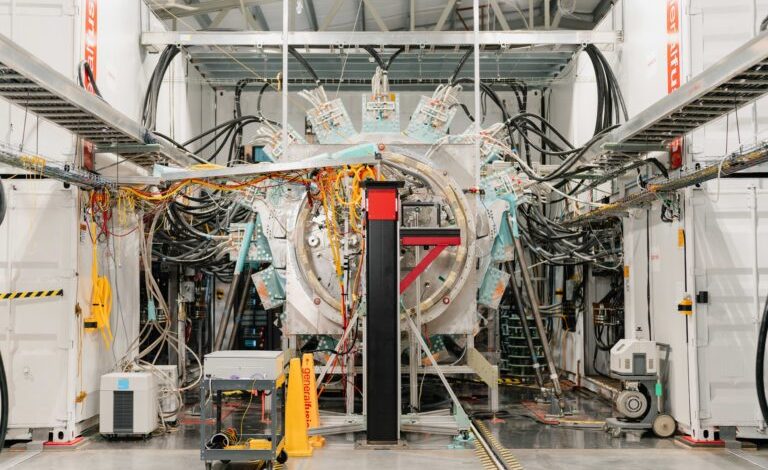
Canadian fusion company General Fusion has achieved a major milestone in its LM26 demonstration machine, reaching electron temperatures above 1 keV, equivalent to more than 12 million degrees Celsius. The result was achieved using the company’s Magnetized Target Fusion approach and was measured in collaboration with the UK Atomic Energy Authority (UKAEA). The organizations described the result as the first 1 keV achievement using low-speed plasma compression.
Measurements using Thomson scattering, a widely established technique for determining plasma temperature, recorded approximately 1.1 keV, or 12.6 million degrees Celsius, shortly before peak compression. A separate extreme-ultraviolet diagnostic recorded approximately 1.2 keV, equivalent to 13.7 million degrees Celsius, during peak compression. General Fusion also reported ion heating to approximately 0.46 keV, providing additional evidence that the compression process is producing the intended heating effects.
The achievement is significant because General Fusion is pursuing a different route from approaches that rely on extremely powerful lasers or very rapid compression. Its Magnetized Target Fusion technology first magnetically confines the plasma and then compresses it over milliseconds. The LM26 system uses a metal wall for the compression process, while the company’s eventual commercial design is intended to use a liquid-metal wall that could help protect the reactor from neutrons, breed fusion fuel and transfer heat for electricity generation.
Reaching 1 keV does not mean General Fusion has produced commercially useful fusion electricity. The company still needs to demonstrate the combination of temperature, plasma density and confinement time required to reach the Lawson criterion for net fusion energy. Its next major LM26 target is 10 keV, and upgrades to the machine are already underway to achieve higher compression ratios. General Fusion says the LM26 programme is ultimately intended to support a first-of-a-kind commercial fusion plant around 2035.
The result nevertheless represents an important step in the broader race to commercialise fusion energy. General Fusion says its approach is designed to avoid superconducting magnets and high-powered lasers while potentially reducing the complexity and cost of a future power plant. The company’s results are being submitted for peer review, and the next stages will determine whether the promising plasma-heating milestone can be translated into the much harder goal of sustained, economical fusion power.




