Total Solar Eclipse Crosses Europe in Rare Celestial Event
The only total solar eclipse of 2026 is crossing Greenland, Iceland and northern Spain, while much of Europe experiences a partial eclipse.

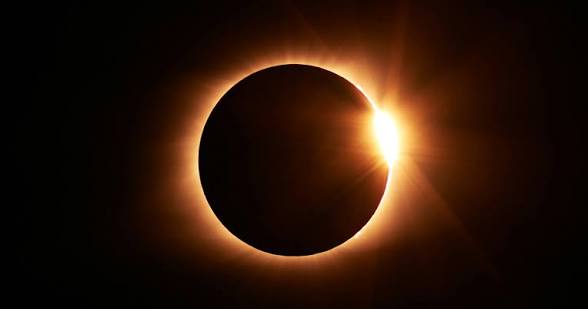
A rare total solar eclipse is crossing parts of Europe today, August 12, 2026, creating one of the year’s most significant astronomical events. The Moon is passing directly between Earth and the Sun, completely blocking the Sun’s bright disk for observers along the narrow path of totality. The event is particularly notable because total solar eclipses are relatively uncommon from any specific location.
The path of totality is stretching across Greenland, Iceland and northern Spain, with a small section of northeastern Portugal also experiencing totality. In Spain, the eclipse is occurring close to sunset, creating an especially dramatic viewing opportunity. The maximum duration of totality is approximately 2 minutes and 18 seconds, according to NASA eclipse data.
Although only a narrow region experiences complete darkness, the eclipse is visible in partial form across a much wider area. Large portions of Europe and parts of North Africa are seeing the Moon cover some portion of the Sun. This makes the event accessible to millions of people even outside the central path, although the appearance and timing vary depending on location.
The eclipse is also providing scientists with an opportunity to study the Sun’s outer atmosphere, known as the corona. During totality, the Moon blocks the overwhelming brightness of the solar surface, allowing researchers to observe the faint corona and investigate processes involving solar magnetic fields, plasma and the solar wind. NASA and other scientific organizations are conducting observations during the event to gather additional data.
Beyond its scientific value, the eclipse is a major astronomical spectacle for observers across Europe. It is the first total solar eclipse visible from parts of mainland Europe since 1999, making today’s event particularly memorable for skywatchers. The eclipse demonstrates how precisely the movements of the Earth and Moon can produce a spectacular natural event—and gives scientists another opportunity to study our nearest star.