WORLD CUP 2026: France vs. Morocco — When my heart chose Africa
A rematch four years later, a different Morocco, a different World Cup

By Paul Lucky Okoku
Some World Cup matches are simply knockout games. Others become conversations about history, identity, tactics, and the evolution of world football.
France versus Morocco belongs to the second category.
Four years after their memorable semifinal in Qatar, they meet again with another place in history at stake.
The Dilemma Before Kickoff
Every football analyst occasionally encounters a match that is difficult to approach with complete emotional detachment.
France commands admiration for its extraordinary football tradition, technical excellence, and ability to produce world-class talent generation after generation.
Morocco represents something equally compelling. Its remarkable rise has become one of the defining football stories of this generation, inspiring millions across Africa and proving that disciplined planning, sound coaching, and unwavering belief can elevate a nation to the highest level of the game.
My own experiences against Morocco more than four decades ago, together with the opportunity to spend time with Moroccan supporters during this World Cup in Atlanta, add another layer to this particular quarterfinal.
But this match deserves to be judged not by nostalgia.
It deserves to be judged by football.
France versus Morocco is more than a rematch. It is a fascinating contest between technical excellence and tactical discipline, individual brilliance and collective organization, established power and emerging confidence.
That is why this quarterfinal deserves our full attention.
So today, as France prepares to meet Morocco once again on the World Cup stage…
Who do I support?
A Quarterfinal Four Years in the Making
This is more than another knockout match.
It is a rematch of the 2022 FIFA World Cup semifinal, where France defeated Morocco 2–0 to end one of the greatest underdog stories in World Cup history.
But Morocco is no longer simply a surprise package.

The Atlas Lions have become one of the world’s most respected football teams.
France remains one of football’s global powers.
Morocco has become one of football’s greatest success stories.
That makes this quarterfinal one of the most fascinating tactical battles of the tournament.
Match Information
Competition: FIFA World Cup 2026 – Quarterfinal
Match: France vs. Morocco
Date: Thursday, July 9, 2026
Kickoff: 4:00 p.m. EDT
Previous World Cup Meeting: France defeated Morocco 2–0 in the 2022 FIFA World Cup semifinal in Qatar.
Recent Form (Last Five Matches):
France: 5 consecutive victories.
Morocco. 4 victories and 1 draw, remaining unbeaten in its last five matches.
Head-to-Head (World Cup):
Meetings: 1
France: 1 win
Morocco: 0 wins
Draws: 0
Statistics provide useful context, but World Cups are rarely decided by statistics alone. Every knockout match writes its own story, and no amount of history can score the next goal.
France enters as the favorite. Morocco enters believing it can make history once again. That belief may prove to be the most dangerous weapon of all.
On paper, France appears to hold the advantage. On the pitch, however, paper rarely wins football matches. The World Cup has reminded us repeatedly that reputations, rankings, and historical records disappear the moment the referee blows the opening whistle.
From that moment forward, only performance matters.
And until the final whistle sounds, every prediction remains exactly that—a prediction. Football has never been played on paper. It is played on the pitch.
France: Built for Tournament Football
Few countries develop football talent like France.
Its academy system continues to produce elite players.
Its squad possesses remarkable depth.
Its attacking players can decide matches in moments.
Its midfield controls tempo.
Its defense rarely loses composure.
Most importantly…
France understands tournament football.
They know how to win.
Experience matters.
Morocco: Africa’s New Standard
Morocco has become much more than a disciplined defensive side.
The Atlas Lions defend together.
Attack together.
Press intelligently.
Transition with speed.
Remain tactically organized.
Most importantly…
They believe.
Confidence changes football matches.
This Morocco side no longer walks onto the pitch hoping to compete.
It expects to win.
Tactical Chess Match: Where the Quarterfinal Will Be Won
This match is unlikely to be decided by possession.
Both coaches understand that knockout football punishes impatience.
France will attempt to stretch Morocco’s defensive shape by attacking the wide areas before quickly switching play into central attacking channels.
Morocco, meanwhile, will remain compact, forcing France to play around rather than through them.
The team that succeeds in disrupting the other’s preferred rhythm will control the match.
France’s Technical Superiority
France arguably possesses greater individual technical quality across the pitch.
Its first touch under pressure is exceptional.
Its ability to combine in tight spaces is among the best in international football.
Its attackers require very few opportunities to create goals.
When France accelerates its passing tempo, opponents often struggle to recover defensively.
That technical efficiency explains why France remains one of the world’s most consistent tournament teams.
Morocco’s Tactical Superiority
If France enjoys the technical edge, Morocco may hold the tactical advantage.
Morocco rarely loses its defensive structure.
Its players understand spacing.
Distances between defenders and midfielders remain compact.
The team shifts together.
Presses together.
Defends together.
Few teams in this World Cup have demonstrated greater tactical discipline.
Morocco may not always dominate possession.
It frequently dominates organization.
That is often enough to defeat technically superior opponents.
The Battle That May Decide Everything
Quarterfinals are rarely decided by eleven players.
They are often decided by one mistake.
One defensive lapse.
One set piece.
One moment of brilliance.
France has the individual stars capable of producing those moments.
Morocco has built its success by minimizing them.
That contrast makes this one of the tournament’s most intriguing tactical battles.
The Story of Issa Diop: When Heritage Found Its Home
Modern football is increasingly shaped by heritage as much as birthplace.
Few players illustrate that better than Issa Diop.
Born in Toulouse, France, Diop developed through the French football system and represented France at youth international level.
His father is Senegalese.
His mother is Moroccan.
Like many dual-national footballers, he dreamed of representing France at senior level.
That opportunity never came.
Rather than allowing disappointment to define his career, Diop embraced another part of his identity.
In 2026, he committed his international future to Morocco through his mother’s heritage.
Football has a remarkable sense of timing.
Against the Netherlands, with Morocco facing elimination, it was Issa Diop who scored the dramatic late equalizer that kept Morocco alive before the Atlas Lions advanced on penalties.
Sometimes football closes one chapter only to begin another.
Morocco Represents Morocco First
One debate always resurfaces whenever Morocco enjoys international success.
Does Morocco represent Africa?
Or only Morocco?
The answer is simple.
Morocco represents Morocco first.
Exactly as Nigeria represents Nigeria.
Exactly as Ghana represents Ghana.
Exactly as Senegal represents Senegal.
That is how international football works.
Every nation plays for its own flag.
Its own anthem.
Its own people.
But success has a way of crossing borders.
When Morocco wins…
Children in Lagos notice.
Children in Accra notice.
Children in Nairobi notice.
Children in Johannesburg notice.
Whether Morocco claims to represent Africa or not is ultimately beside the point.
Its success inspires millions of Africans.
That inspiration cannot be measured.
Nor can it be denied.
Morocco: Africa’s Last Hope
As the quarterfinals begin, *Morocco stands as Africa’s only remaining representative* at the 2026 FIFA World Cup.
That reality carries both pride and responsibility.
Every nation arrives at the World Cup to represent its own flag first. Morocco owes nothing more than its best effort to the Moroccan people.
Yet football has always transcended national borders.
When Cameroon reached the quarterfinals in 1990, Africa celebrated.
When Senegal reached the quarterfinals in 2002, Africa celebrated.
When Ghana came within a penalty kick of the semifinals in 2010, Africa celebrated.
When Morocco became the first African nation to reach a World Cup semifinal in 2022, Africa celebrated.
Today, Morocco carries that tradition forward.
Whether Moroccans describe themselves first as Moroccan, African, Arab, Amazigh, or all of the above does not change one undeniable fact.
Morocco is Africa’s last remaining hope in this tournament.
If the Atlas Lions advance, African football advances with them.
If they fall, Africa’s challenge at World Cup 2026 comes to an end.
That is not a political statement.
It is simply the reality of the tournament.
Rankings Never Score Goals
France enters this quarterfinal as the *No. 1 ranked team in the FIFA Men’s World Ranking.
Morocco enters as the No. 6 ranked team in the world and Africa’s highest-ranked nation.
Those rankings deserve respect.
They do not guarantee victory.
This World Cup has reminded us of one timeless football truth.
History does not score goals.
Reputation does not defend corners.
Rankings do not win knockout matches.
Performance does.
Possession may help protect a lead
History may inspire confidence.
Rankings may shape expectations.
But none of them guarantees victory.
Until the referee blows the final whistle, no lead is truly safe.
So…Who Do I Support?
If football were only about tactics…
France might be the logical choice.
If football were only about individual brilliance…
France might still be the logical choice.
But football is also about stories.
About journeys.
About identity.
About shared experiences.
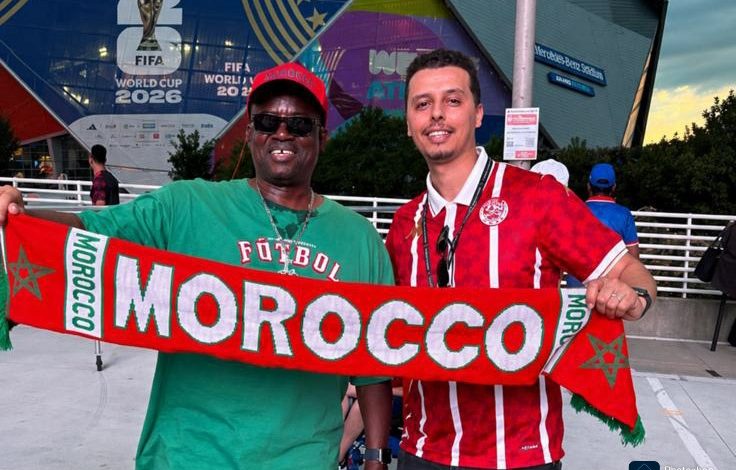
A few days ago, I stood outside Mercedes-Benz Stadium with Moroccan supporters holding their scarf.
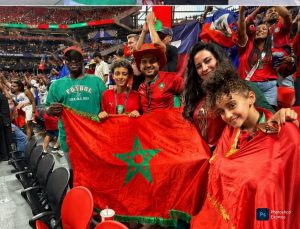
Later, inside the stadium, I held Morocco’s national flag alongside a Moroccan family while more than 68,000 fans celebrated one of the World Cup’s great occasions.
Forty-two years earlier…
I had played against Morocco.
Football brought us together again.
Not as opponents.
But as friends.
Final Whistle
France has earned the world’s respect.
Morocco has earned the world’s admiration.
One represents one of football’s greatest traditions.
The other represents one of football’s greatest modern success stories.
My admiration for France is genuine.
Its football deserves enormous respect.
But today…
My choice is clear.
Not because Morocco asked for my support.
Not because France lost my respect.
But because when I raised the Moroccan flag in Atlanta, I saw something larger than one football match.
I saw an African nation carrying the hopes of millions across an entire continent.
Today…
My football mind admires France.
My African heart stands with Morocco.
And if the Atlas Lions continue their remarkable journey…
Africa will celebrate—not because Morocco stopped being Moroccan, but because one African nation once again proved that it belongs among the very best in world football.
As an analyst, I see a match between technical excellence and tactical discipline.
France may possess greater individual quality.
Morocco may possess greater collective organization.
Whichever philosophy prevails will likely determine who advances to the semifinal.
As a former international footballer, I respect both.
As an African, my heart is with Morocco.
But as an analyst, I know football owes no one victory. Every team must earn it over ninety minutes—or longer.
The Okoku Football Maxim
The scoreboard tells us where the match stands.
Football rewards performance, not reputation.
Until the referee blows the final whistle, no lead is truly safe.
Paul Lucky Okoku, FIFA Legend , CAF Silver Medalist , Former Nigerian Super Eagles & Flying Eagles International, Former Olympic Qualifying Team Member, Football Analyst and Founder, GTCF writes from Atlanta, USA