Hubble Data Reveals Andromeda’s Star Formation Is Rapidly Declining
NASA’s Hubble Space Telescope has mapped hundreds of millions of stars in Andromeda, revealing that the nearby galaxy has been producing fewer new stars for about 500 million years.

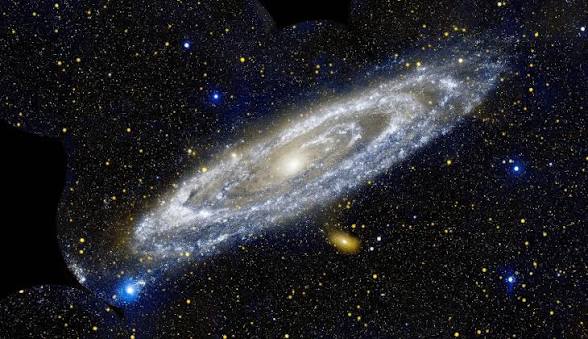
NASA’s Hubble Space Telescope has provided astronomers with an unusually detailed look at the history of star formation in the Andromeda Galaxy, our nearest major galactic neighbor. By analyzing observations covering roughly two-thirds of Andromeda’s disk, researchers were able to study about 200 million individual stars and reconstruct how star formation has changed over hundreds of millions of years.
The research shows that Andromeda’s star-formation activity has been declining for approximately 500 million years, with the decrease becoming particularly sharp during the past 40 million years. About 500 million years ago, the galaxy was forming stars at a rate equivalent to roughly one Sun’s mass per year. The findings provide scientists with a detailed picture of how a large spiral galaxy gradually becomes less active in producing new stars.
Scientists believe the decline may be connected to Andromeda’s complex history of interactions with other galaxies. Previous research has indicated that Andromeda experienced a major burst of star formation around two billion years ago, potentially triggered by a close encounter or merger involving another galaxy. Such interactions can dramatically influence the distribution of gas and dust, the raw materials required to create new stars.
The Hubble observations are especially valuable because Andromeda is close enough for individual stars to be resolved in extraordinary detail. Instead of examining the galaxy only as a single glowing object, astronomers can study its stellar populations and determine which regions contain younger stars and which are dominated by older generations. This allows researchers to reconstruct the galaxy’s evolution and compare it with the history of galaxies like our own Milky Way.
The discovery offers a broader look at how galaxies age. Andromeda is not suddenly becoming inactive, but its declining star-formation rate shows that galaxies can gradually transition from periods of intense stellar activity toward quieter stages. By studying this process in our neighboring galaxy, astronomers can better understand how galaxies evolve and what may happen to the Milky Way over extremely long timescales. Hubble’s observations therefore provide more than a snapshot of Andromeda—they offer a record of its changing history written across hundreds of millions of years.